
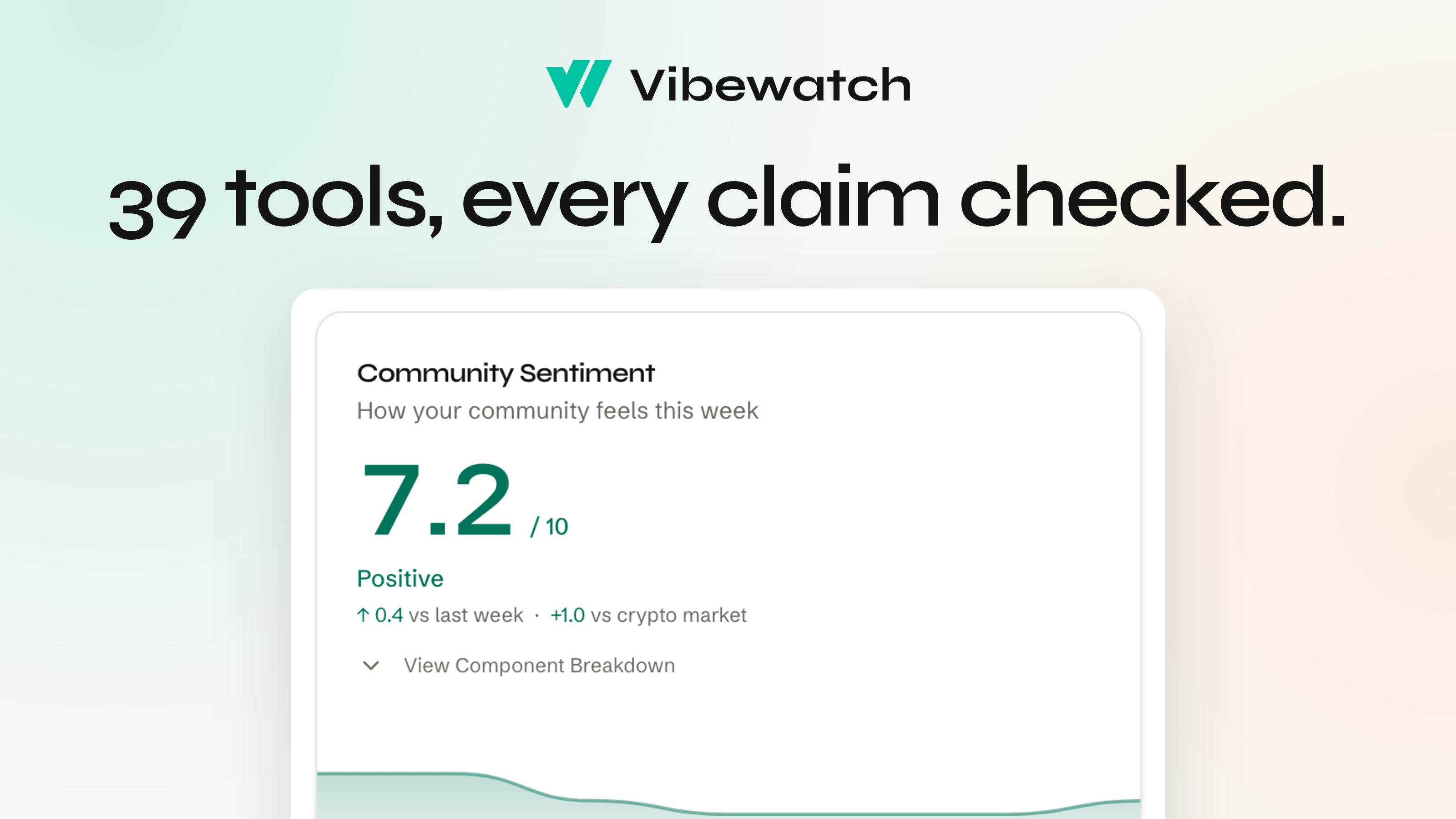
In June we published our first state-of-the-market report on community management tools, 32 products checked against their own docs. Three weeks later the market started rewriting it.
On July 1, Mention stopped selling to new customers. The next day Zoom announced it was buying Common Room, which it now sells to sales teams. Over the summer Dash Social took its prices off the page. And June's map left out an entire market, the bots that sit in your Discord and answer members themselves.
So I ran the comparison again from scratch, with a stricter method, and this version replaces June's. We're now at thirty-nine tools that still sell "community sentiment" in some form, plus four that no longer can. Every claim about them was read off the vendor's own pricing page or help center, and for the 37 in the September count, a second reader then attacked each claim with the sole job of proving it wrong. The sources are at the bottom, tool by tool. I built Vibewatch, and it's in this comparison too. Every claim about it was checked against Vibewatch's own code, and it gets its own section on where it loses.
The reader I had in mind is a six-person web3 team. One of them runs community and social, and reads the Discord and the Telegram every day, but struggles to consistently bring community insights back to the rest of their team. What they learn stays with them. A handful of messages on a busy day that needed an answer from someone on the team get found by luck. They have a scrappy budget, under $500 a month. Their ideal tool needs to help them make two things happen: the community's week reaches the whole team, and the messages that need a reply get found the day they're posted.
The decision, first
Four criteria decide it for that team. A tool has to read inside the Discord server and the Telegram group, from membership rather than a public web view. It has to score every message it reads against your project's own context. It has to write the week up for people who weren't in the channel. And it has to tell the community lead which messages need a reply today, without needing any sketchy account permissions.
| Tool | Reads inside Discord and Telegram | Per-message sentiment, scored for your project | Learns from your corrections | Weekly narrative for the team | Finds the messages that need a reply | Entry price |
|---|---|---|---|---|---|---|
| Vibewatch | Both, via bot membership | 1–10 sentiment and relevance, with your brand context | Sentiment and relevance corrections become standing rules | Yes, cited to the messages, plus an optional daily brief | Replyability 1–10, most urgent first; you post natively, and their post leaves the queue once your team replies | $19/mo |
| Sift AI | Both, via bot membership | A per-message score (its docs disagree on the scale) | Learns which messages to skip from your team's decisions, and your voice from draft edits; nothing from score corrections | Daily briefings and weekly reports from scheduled agents | Needs-reply and urgency flags; drafts for review; first-response and SLA stats | Demo only |
| Sprinklr | Both, via your own bot, owned servers and groups only | Three buckets; sentiment on group messages is a use case in one help article and "likely" in another | Feedback "stored in the backend"; custom model is a paid module | "Themes, trends and anomalies", on its marketing page | Engagement columns | Enterprise quote |
| CommunityOne | Discord only | Three buckets, weekly, on high-signal messages; scoring method not documented | No published documentation | AI-written weekly report on the $150 tier | A list of issues needing an answer, on the $350 Ops tier | $150/mo for sentiment |
| Pulsar TRAC | Discord (your own server, via bot); Telegram on the marketing page only | −1 to +1 per post | Override per post; custom model at extra fee | GPT-4 alert summaries | No | Enterprise quote |
| Brand24 · Awario · Mentionlytics · YouScan · Octolens · Agorapulse | No Discord on any published source list; Telegram only where it's public | Three buckets (Octolens adds relevance) | YouScan's help center says within a topic; Octolens for relevance; the rest none documented | AI summaries on some tiers; none documented at Awario | Agorapulse has an inbox for owned accounts, and Awario lets you reply in-app; none reach chat platforms | $49/mo (Awario, monthly) to $499/mo (YouScan, billed annually) |
| Mava · Pluno · Relayn · Wallu | Both, via bots that post (Relayn added Telegram on October 4) | None per message | Learn answers from mods and docs | Relayn sends digests; the others don't | Three keep unanswered-question lists; all four answer for you | Free tiers at all four; paid from €6.99 (Wallu), $20 (Relayn), and $39 (Mava) to €99 (Pluno) |
How every claim was checked
Every live tool was checked against the same fifteen-row rubric, with rows merged or split where a tool's category called for it, except Converseon, which got three rows (status, price, and correction learning). The fifteen rows cover status, entry price with billing cadence, Discord access, Telegram access, other sources, sentiment granularity, brand-relevance scoring, what happens when you correct a label, reply and engagement behavior, alerts, output unit, AI narrative, who the vendor says it's for, anything web3-specific, and operating constraints like retention and export. A row only counts as a claim if it comes from the vendor's own page, with a quote and a date. Third-party listicles were useful for leads, but they never counted as evidence.
Then a second reader, one who hadn't written the sheet, tried to kill every row using a different kind of page. Pricing claims were checked against the help center, and help-center claims against the pricing page or changelog. Every row ended up with one of four verdicts. Survives means a second vendor source agrees. Killed means one contradicts it. Narrowed means it's true, but with a qualifier the first reader missed, usually billing cadence, plan tier, or owned-versus-public access. Unverifiable means only one source exists and nothing else on the vendor's site speaks to it. Nothing unverifiable is stated as fact in this piece.
Negatives got the strictest rule of all. "No Discord" is never written here as a bare fact. When this piece says it, it means the platform is missing from the vendor's published source list on a named page, as of November 22, 2026, or that I couldn't find documentation on the pages I checked. A vendor could ship a connector tomorrow, and the sentence would still have been true when it was written.
If a price only exists inside an app you have to log in to, the article says so and doesn't name a figure. If a vendor publishes no price, it says "quote". All told, that's 540 rows across the 37 tools, the four that are gone, and three partial checks. Twenty rows were killed, 82 were narrowed, and 23 came back unverifiable. Two more tools turned up after the count, collony.ai in October and KAI by AmaZix in November. Both are covered here from their own pages, with the quotes in a dated addendum to the ledger, outside the 540. Vibewatch isn't in that count either; its claims were checked against its own code.
In June I led with 338 agents and roughly twelve million tokens. Those numbers measured effort. The counts above measure what survived, and that's the number that should have been in the headline the first time.
Six markets sell "community sentiment"
Every tool that claims the phrase was built for one of six customers. The sixth is the market June's map missed.
Trader tools
Six tools sit in this group: LunarCrush ($90/mo monthly, with daily and annual billing), Santiment ($49/mo), Kaito (one seat, $833/mo billed annually or $1,099 month to month), Moni, TheTIE, and Cookie3. All but Cookie3 score the market's attention per asset so someone with a portfolio can act on it (the guide to crypto social listening tools sorts them by job); Cookie3 tracks KOLs and wallets for crypto marketing teams and documents no sentiment metric at all. Moni has pivoted. It's now a trading terminal with smart-money wallets and one-click swaps, and the Telegram bot it adds to groups reads the chat to answer pasted X handles and links. Of these, Kaito is the one now pitching "social listening" to project teams. Its current docs list Telegram among its "public datasets", and pages last edited in November 2024 list Discord as well, but none of them says how it reaches either one.
Enterprise suites
Ten enterprise suites made the list: Sprinklr, Brandwatch, Meltwater, Sprout Social, Hootsuite with Lumen by Talkwalker, Emplifi, Khoros, Dash Social, Pulsar TRAC, Converseon. Listening is an add-on almost everywhere, and the price of the add-on is published almost nowhere. Sprinklr no longer sells anything self-serve, and Meltwater's contracts start at twelve months. Khoros was bought by IgniteTech, which launched khoros.ai on top of it. Emplifi's plans now start at $1,249 a month, and listening is an add-on it doesn't price.
SMB keyword listeners
Brand24 ($249/mo, $199 annual), Awario ($49/mo; its pricing page shows $29 on the annual toggle), Mentionlytics ($199/mo, $149 annual), Agorapulse ($99/user/mo, $79 annual; its Advanced Listening add-on is priced through sales after a 30-day in-app trial), YouScan ($499/mo annual), Octolens ($199/mo, $159 annual), Keyhole (now a Muck Rack demo form), and what's left of Mention all take your keywords and hand back a stream of mentions from across the public web.
Counters and digests
Statbot covers Discord, and TGStat, Combot, and Junction Bot cover Telegram. Statbot and Combot sit in the channels as bots, TGStat crawls the public Telegram directory, and Junction Bot reads private chats through an account you connect. All of them measure activity: messages per day, growth, heat maps, a topic digest. TGStat also sells real-time keyword monitoring across the channels and chats it indexes, 1,050 rubles a month per topic, and Combot's AI now answers members who mention it in the group. Both go beyond counting, so June's line that these tools "only count" doesn't hold anymore.
Community platforms that score sentiment
Common Room, CommunityOne, BetaHub, and Levellr are Discord-native tools with a sentiment layer, each aimed at a different buyer: revenue teams, Discord server owners, game studios, and enterprise game and music brands, respectively. Levellr is the only one of the four without a published price.
Bots that answer inside the chat
Mava, Pluno, Relayn, and Wallu are self-serve, and Sift AI is the one enterprise entry. Two more turned up after the September count. collony.ai is a Telegram and Discord moderation bot that also answers, and the Insights on its $99 Grow plan score the chat's sentiment message by message. KAI by AmaZix comes from a web3 community-management company and answers on Telegram, Discord, or Twitch, one platform from $79 a month and all three from $799, both billed annually; the dashboard on its homepage shows one sentiment score for the whole community. These are the tools a web3 team searching for "Discord community tool" will meet first, and they fix a real problem by answering the questions nobody on the team got to. They post replies themselves, from a knowledge base, and most of them list what went unanswered. None of the first four scores a message's sentiment. Mava lists web3 and crypto among its main markets, and Pluno names Scroll, Dune, and Aave among the communities it runs in.
None of the six markets was built for the person who runs the community and needs the rest of the company to know what it said.
What changed since June
- Mention stopped selling its product as a standalone as of July 1, 2026. Existing customers keep their plans; new buyers are sent to Agorapulse's listening add-on through sales. The pricing page now shows a single Company plan with no number on it, a demo button, and a trial button that leads to Agorapulse. The last published figure was $599/mo, billed yearly. Publishing and replying were retired on January 30, 2026.
- Common Room was acquired by Zoom, announced July 2, closed in July. The pricing page still says Essential is $2,500/mo billed annually, and the Discord integration doc is still maintained, but the product is sold as buyer intelligence for sales teams.
- Sprinklr discontinued its self-serve products; in September its demo page put the end of service at April 30, 2026. Today its free-trial page forwards to a demo request, and its pricing page returns a 404. Its Discord integration now reads channels, private channels, and forum threads through a bot you create and add yourself, on your own public servers: its help center says a private server can't be added.
- Hootsuite renamed its listening to Lumen. Every plan now includes Quick Search, with sentiment analysis and "Wisdom AI summaries". The Standard seat, $99 per seat a month when billed yearly (monthly billing costs more, and the page doesn't print it), searches the past seven days, and Professional and up search the past 30. The full Lumen by Talkwalker is an Enterprise add-on with no published price. The ~$9,600 a year figure June cited for listening appears on no vendor page today.
- Dash Social removed the $999 and $1,999 prices from its pricing page since the August snapshot; every tier is a demo now.
June's write-up is also out of date on two enterprise suites.
- Khoros was acquired by IgniteTech in 2025, and khoros.ai launched in 2026, with Aurora AI for branded communities and Iris AI for social listening and care. It publishes no pricing.
- Emplifi now publishes starting prices: $1,249/mo for Essential, $2,499/mo for Advanced. Listening is an add-on with no price shown.
Then there are the smaller moves, and each one changes a row for our six-person team.
- Mentionlytics rebuilt its plans in November. Its entry plan, Essential, now costs $199 a month ($149 billed annually), up from $69, and Telegram only arrives at Pro, $599 a month ($449 billed annually).
- Agorapulse now publishes monthly-billed prices alongside annual, and added an AI "Listening Screening" that separates real brand mentions from keyword coincidences.
- Moni became moni.ai, an "intelligence and trading layer", with a free plan beside tiers at $120 and $250 a month; its docs list a 0.1% trading fee.
- Pluno, the Discord and Telegram community bot formerly AwesomeQA, now leads with a Zendesk support agent from €850 a month billed annually. The community product is still sold, on its own pricing page: free for 10 answers a month, then €99, €190, and €290 a month.
- CommunityOne added an Ops tier at $350/mo on top of its $150 Enterprise Core: "a daily briefing of unanswered questions, new members, and quieter regulars," with an ops dashboard shipped in July.
Reddit data got harder to keep, and the shutdowns June recorded are holding.
- Brandwatch's help center announced a Reddit coverage change: from August 28, 2026, history is cut to thirteen months in Consumer Research and twelve in Listen, legacy Reddit data went away when the transition ended on September 30, and some posts now arrive up to about thirty hours late. It's one more sign of where Reddit licensing is going.
- GummySearch's timeline held: closed to new signups November 30, 2025, with every service and all user data to be deleted on December 1, 2026. Threado's homepage carries a one-line shutdown banner over an otherwise intact marketing page. Orbit's domain no longer resolves. Coindive was live in April; today its domain fails DNS, its App Store listing is gone, and the vendor has posted no notice.
Some prices didn't move at all: LunarCrush is still $90 billed monthly, Santiment $49, Kaito's $833 annual rate, Brand24 $249, Awario $49 (its pricing page's monthly figure), YouScan $499, Octolens $199, Common Room $2,500, and Cookie3 from $59.
Which tools read the server and the group from the inside
"Supports Telegram" can mean three different things. A Telegram channel is a broadcast: an admin posts, everyone else reads, and any tool can scrape the public web view of it. A Telegram group is where the community talks to each other, and a tool reads it by being in it: a bot an admin adds, or an account that joined. Discord has no public view at all; a server is a space you're added to, so reading it means a bot with membership. Pointing a scraper at a public channel is just source configuration, while being added to a group is an access grant. (The Discord and Telegram guides go tool by tool on each platform, and Vibewatch's Discord and Telegram pages show how it reads each one.)
Bot membership in Discord. Vibewatch, Sprinklr (a bot you create; its help center allows public servers only), Common Room, CommunityOne, BetaHub, Pulsar TRAC (your own server, real-time only from the day the bot joins), and every answer bot: Mava, Pluno, Relayn, Wallu, collony.ai, KAI by AmaZix, Sift AI. Statbot is in the server too; it counts.
Bot membership in a Telegram group. Vibewatch (a bot you create in BotFather and make an admin of the group), Sprinklr (owned groups only; its help center says listening "is not supported for earned mentions"), Mava, Pluno (set up by hand by Pluno's team), Wallu, Relayn (the bot must be a group admin), collony.ai, KAI by AmaZix, Sift AI. Moni's bot sits in groups with admin rights to answer link lookups, and Combot is in the group as a moderator.
Telegram read from outside, without joining. Brand24 ("scans public Telegram channels for mentions automatically"; its own pages disagree on public groups), Mentionlytics (Pro tier and up; "posts only on public channels" per its help doc), Santiment (a scraper over a curated list of 400-plus crypto chats), YouScan (its help article on channel collection lists "public channels and chats", added by t.me link, which is broader than June credited it with), Pulsar TRAC on its marketing page.
Listed, mechanism undocumented. Meltwater's published platform list includes Discord and has since before June; the only description of how, from a Meltwater employee's 2024 community post about Radarly, is monitoring public messages in your own public servers, "in selected industries". Kaito's docs list Telegram among its "public datasets", and three older pages, last edited November 2024, list Discord; none describes a bot, an invite, or a scrape. Both are corrections to June, which said no for both. Meltwater also sells Telegram Monitoring in its Explore product, a premium add-on "powered by DarkOwl" that brings "curated Telegram data" into monitoring for communications, security, and risk teams; its update doesn't say which chats that data covers. Levellr's setup guide has you authorize a bot; its platform pages don't say how listening connects.
Not on the published source list. Brand24, Awario, Mention, Mentionlytics, Agorapulse, Keyhole, YouScan, and Octolens for Discord, with the page checked cited in the sources section for each. Sprout Social, Brandwatch, Hootsuite, Emplifi, Dash Social, LunarCrush, Cookie3, TheTIE for both; Santiment for Discord. As of November 22, five months after June's report, that's still the entire SMB listening tier with no Discord source. Octolens's platform list still shows no Discord, but its API reference documents connecting a Discord server through a bot, a source it hasn't enabled for every workspace yet.
For our six-person team, one column matters most: tools that read both the Discord server and the Telegram group from the inside, score what's there, and cost under $500 a month. With a published price, Vibewatch is the only one that also scores them next to X, Reddit, Bluesky, YouTube, Discourse forums, GitHub Discussions, and the web3 networks Farcaster, Lens, and Nostr, and it reads Snapshot and ballot.gg governance votes too. As of November 22, Lens, Nostr, Snapshot, and ballot.gg are on no other published source list in this comparison, and Farcaster is on one, Kaito's. Sift AI does the Discord, Telegram, and public-social part, but doesn't publish a price. collony.ai reads both for $99 a month and scores sentiment message by message, but it's a moderation and answer bot with no public-social source. Sprinklr does the reading and sells by enterprise quote; one of its help articles names group-message sentiment as a use case, and neither capabilities table includes it.
Whose sentiment learns your brand
Every listening tool in this comparison advertises AI sentiment. Of the answer bots, only Sift AI and collony.ai score messages one by one (collony.ai in the Insights on its Grow plan); Relayn's site claims community sentiment for a server as a whole, KAI by AmaZix shows one score for the whole community, and the other three document none. None of the counters scores it (Junction Bot suggests it as a job for your own prompt), and Cookie3 documents no sentiment metric. In June the test was to ignore the marketing page and read the help center, to find out what happens when you correct a wrong label. This time I asked the same question of all thirty-nine, and three of June's answers changed.
Brandwatch isn't one of them. Its Listen help article, now on Cision's help center, still says changing a label "will not affect how sentiment or emotion is calculated for future mentions." So the score you fix stays fixed, and the next message gets scored the same way as before. Its Consumer Research product sells custom classifiers you train yourself to sort mentions however you like, and publishes nothing on whether edits carry forward there.
Meltwater is a correction I owe from June. The 2019 engineering post reads, in full: "Until now, sentiment overrides have never been fed back to the sentiment models. The NLP team has now designed a feedback loop." An override changes your own view of that document. Overridden documents then go to Meltwater's annotators for relabeling, get screened so that anything "representing a specific customer bias requiring a specialized model" is left out, and the sound ones join the test set ("we don't want to overfit that data point by adding it to the training set") while Meltwater collects similar data to retrain the shared model. So your corrections steer Meltwater's model indirectly, for everyone, and by design never for you alone. No Meltwater page published since says whether that loop still runs. June's "engineered against learning your brand" was the right conclusion from the wrong quote.
Sprout Social says reclassifying an unclassified message "helps to train Sprout's machine learning model to make more accurate predictions in the future", that reclassifications "do not transfer to other Topics", and, in a separate article on its AI, that its models "learn from large, general, and deidentified datasets—not your specific customer information." Sprout's pages don't say whether that model is shared across customers, so I won't say it either.
Sprinklr updated its sentiment page the day I fetched it. It now describes "a single, domain agnostic model" that "is trained once", and says: "Rather than retraining the model for each partner or domain, Sprinklr tailors the LLM's behavior using natural language prompts." Corrections are "stored in the backend." A custom sentiment model exists in AI Studio, "a paid module, available on-demand."
YouScan's help center still says it learns within a topic: change a label "so the algorithm can learn from your edits and constantly increase the accuracy of its sentiment analysis in your topic." It uses three buckets, costs $499/mo billed annually, documents no Discord source, and reads public Telegram.
Lumen by Talkwalker lets you train custom AI classifiers yourself for brand sentiment, "if AI Classifiers are a part of your package", inside the Enterprise add-on, with no price published. June called this a services project, but the vendor's own tutorial and help center show customers doing the training themselves, so that's corrected here.
Octolens now has a partial loop, which June missed. Marking a mention relevant or not "feeds the relevance model, so the same mistake gets rarer", and the reason you type is passed to the relevance agent. Sentiment has a manual override per mention with no documented effect on later scoring.
Common Room says a correction "helps improve Common Room's machine learning-powered sentiment algorithms", and says nothing about whose model that is. Pulsar TRAC offers an override per post and, in a separate help article, custom-built options "at an additional fee". Sift AI learns which messages to auto-close from how your team closes them, and learns your voice from edits to its drafts, with nothing applied until you accept a suggested pattern. It documents no learning from sentiment corrections. BetaHub says your messages are "never used to train models". Converseon sells models fine-tuned to a brand, through its own platform or API. For everyone else, I found no published documentation on the pages checked.
Two of June's broader patterns also narrowed. Granularity is no longer "three buckets everywhere": Sift AI scores each message (its docs give 1–10, 1–5, and 0–10 in different places, so no number here), Pulsar −1 to +1 per post, BetaHub six categories per message rolled up to a 1–5 rating, and LunarCrush, Santiment, and TheTIE score per asset. Relevance is no longer "almost uncontested": Octolens scores it High/Medium/Low, Sprinklr documents an LLM filter (AI Topics) that you steer with written inclusion and exclusion guidelines, Brandwatch sells classifiers you train to sort mentions however you like, and Agorapulse added a screening step.
June's claim holds up this time in a narrower form. No other tool here does all five of these:
- scores every message numerically, on sentiment and on relevance to your project
- puts your project's description and the parent message in the prompt
- turns your corrections into rules for your community automatically
- reads those messages from inside Discord and Telegram
- sells at a self-serve price
Sift AI comes closest, with a per-message score, bots in both chat platforms, and a relevance loop of its own, but it doesn't publish a price. YouScan says it learns, but documents no Discord source. Meltwater's 2019 loop was built to forget who taught it.
Crypto chat is hard on generic sentiment because so much of it only makes sense in context. Take a reply like "mostly memecoins and a prayer." Read on its own, it sounds like someone losing faith. Posted under your project's "what's on your watchlist this weekend?", it's a member joining in.
Vibewatch gives every message a 1–10 sentiment score and a 1–10 relevance score, and when it scores, it has your project description, your own accounts, the message being replied to (or, for an X quote post, the post it quotes), and any attached GIF or sticker in front of it. Your five most recent sentiment corrections ride along as examples in the next pass, and once enough sentiment and relevance corrections accumulate, Vibewatch distills them into standing rules for your community, so a misread like "lfg" scored as neutral in your server gets rarer. On X, Vibewatch also turns recurring noise, like a ticker collision, into exclusion terms for its searches, so those posts are never fetched. (The full mechanics are here.)
Who tells you what to reply to
June didn't compare this at all, and it's where the answer bots compete.
Mava, Pluno, Relayn, and Wallu sit in your Discord (and, for all four, your Telegram) and answer questions from a knowledge base. They post themselves, by default. Mava's public-channel bot needs View Channels, Send Messages, Embed Links, Manage Messages, and Read Message History; Wallu requires View Channels and Send Messages and lists Manage Channels among seven more it can use; Watchdog moderates as well as answers, and its homepage asks you to promote it to "moderator/administrator with permissions to Delete Messages and Ban Members". Three of the four list what went unanswered: Pluno's "unanswered community questions listed for you", Relayn's "Waiting for answer" page, and Wallu's Insights, a beta on its Professional plan, which marks questions "not answered at all". Mava drafts for an agent to review inside private tickets; in public channels all four answer on their own. None of them scores a message's sentiment, and none decides whether a message deserves a person rather than a bot.
CommunityOne's Ops tier ($350/mo) is the nearest priced thing to a triage list: a live list of issues that need an answer, which marks itself done when your team replies, plus new members and quieter regulars in a daily briefing. It's Discord only, and its pages describe no way of ranking which issue needs a person most.
Sift AI is the nearest thing to a triage system, and it runs a deeper reply operation than anything else here. Its docs flag each incoming post with whether "a reply or action is needed" and whether "the post needs attention now", give it a 0–10 actionability score that drives auto-close, and hand each agent the next conversation from a single queue. Its analytics report response rate, first response time, and SLA breaches. Drafts pull from your knowledge base and brand voice, and its docs set a default: "Sift never sends a reply automatically." Sending without review goes through an auto-reply bot, an AI Goal, or a workflow where you turn on automatic sending. It reads Discord and Telegram through bots, scores each message's sentiment, and sells by demo to consumer brands. Its Discord bot requests Send Messages, because replies go out through it.
The suites flag replies too, on the networks they reach. Hootsuite added a built-in "Response Recommended" classifier to its inbox in February that "automatically flags messages that require attention", and Sprinklr's Intent Moderation, a paid offering since its 26.10 release, sorts incoming messages into engageable and non-engageable before routing them. Sprout's Smart Inbox, Brandwatch's Engage, Hootsuite's inbox, and Agorapulse between them cover X, Facebook, Instagram, LinkedIn, TikTok, YouTube, WhatsApp and more through accounts you own; none lists Discord or Telegram. Sprinklr reaches both through the bot you created, in groups and servers you own, in engagement columns. Octolens publishes agent-skill playbooks that let your own Claude or Cursor pull high-relevance mentions over MCP and draft replies, with "Nothing is posted — humans send from their own accounts", for its off-chat sources.
Vibewatch's Engage puts the people in your community who are still waiting on a reply in one queue, most urgent first, across every source you connect. Once a teammate has replied to someone on X, Discord, Telegram, or Reddit, Vibewatch sees it and takes that person's post out. (The launch post shows the queue.)
Behind the queue, Vibewatch makes a second, separate call for every message, after sentiment and relevance, to score replyability from 1 to 10, its estimate of how much the person who posted needs an answer from your team, with a reason attached (a question, a claim worth clarifying, a support issue, feedback, or praise). That call reads the post, any media on it, the message it replies to or quotes, and your brand's own accounts on that platform. Inbound messages land in three bands: 8 and above needs a reply, 5 to 7 worth a reply, 3 to 4 worth a reaction. Three presets set the floor; the default, Balanced, starts at 5, and Relaxed lets the reaction band in. People caught up in an open incident come first. With the defaults, the queue admits a message only if it's aimed at your project (feedback and support issues from other threads count too), posted in the last 48 hours, scored 8 or higher on relevance (7 for a support issue), and written by someone other than your team (on X, a teammate's standalone post can qualify, though their replies can't, so you can join the thread under your founder's announcement). Retweets and your brand account's posts never qualify. A post nobody answers drops out after 72 hours by default, and you can change that window in Settings. Change a threshold or a source toggle, or correct a relevance score, and the queue updates right away.
You write the reply yourself, in Engage's compose box, and Vibewatch helps you get it out. A post in another language shows up translated into English. The box counts characters against the platform's limit, where it has one, and saves your draft on your device as you type. If the poster wrote in Portuguese, Vibewatch translates your draft into Portuguese when you ask, and leaves @mentions, tickers, and links alone. Then it hands the reply to the platform, where you post it natively from your own account. On X, when it has the post's ID, Vibewatch opens X's own composer with the reply already threaded. Otherwise it copies your text and, where it has a link to the message, opens the platform for you. If Vibewatch misses a message, you can add it to the queue yourself.
Then Vibewatch watches for the answer. When your brand account or a teammate you've listed replies natively on X, Discord, Telegram, or Reddit, Vibewatch finds that reply at a later sync and takes their post out of the queue. A reply you carried out to X, Discord, or Telegram waits under Sent when Vibewatch can check for it there (on Discord and Telegram, that takes a teammate listed for the platform). The check runs no sooner than 15 minutes after the hand-off, and on X it searches the thread itself; if it finds nothing from your team, their post goes back in the queue. If your brand's X account is a Verified Organization, its affiliated accounts join your team list when the trial starts. Engage counts how many of those posts your team answered and how many your team missed, and the median time from the member's post to your reply, for the last seven days against the seven before. The weekly report carries the same numbers.
Vibewatch's Discord bot holds View Channels and Read Message History, and there is no X login. On Telegram, Vibewatch reads through your own bot, made with BotFather and added to your group as an admin with no special permissions, the role it needs to read messages. As a group admin that bot could post, and Vibewatch never sends anything through it. Every answer bot that publishes what it asks for (Mava, Wallu, Kapa.ai's install link, Sift AI) includes Send Messages; Pluno, Relayn, collony.ai, and KAI by AmaZix don't publish theirs. An answer bot has to post to do its job, and Vibewatch's queue works without posting anything.
Assume everyone ships Discord tomorrow
Connectors get built. Pulsar already has one for servers you own, and Octolens's API reference documents a Discord bot source that isn't open to every workspace yet. So let's assume every tool above ships a Discord bot and a Telegram bot next quarter, and look at what would still separate them.
Octolens, Awario, and Brand24 give you a mention stream to triage. LunarCrush, Santiment, and Brandwatch give you a dashboard to check, Agorapulse a digest of your own posting metrics, Mentionlytics an AI daily summary from its Advanced tier, Mava a ticket inbox, and CommunityOne a weekly report and an ops list. Vibewatch writes a report on your community every week, cited to the messages. It sets the week against a market benchmark and, if you track one, your token's price, and its Worth Addressing section groups the week's questions, claims worth clarifying, and support issues, with counts taken from the messages themselves. An optional daily brief sends the last 24 hours to Slack, email, Notion, or a webhook. Engage keeps the running list of people still waiting on a reply, refreshed after every sync, and on every plan Claude, ChatGPT, or any other MCP client can query your community data.
Three buckets is still the norm in scoring, with Sift, Pulsar, and BetaHub as the numeric exceptions. The trader tools score per asset, for a portfolio, with crypto-domain context, and the suites carry whatever you write for them: a query, Sprinklr's inclusion and exclusion guidelines for AI Topics, or a classifier you train at Brandwatch or Lumen. Vibewatch gives every community message three 1–10 scores. Sentiment and relevance are scored with your project's description, the rules learned from your corrections, and the parent message (or the post it quotes) in the prompt, and replyability gets its own call that reads the same context.
At Brandwatch, corrections change nothing (its Listen help says so). At Meltwater they steer a shared model after Meltwater's annotators screen out anything specific to you (the 2019 loop). YouScan's help center says they stay inside one topic, Sprout says a reclassification doesn't carry to other Topics, and at Octolens they only touch relevance. Lumen has you train a classifier yourself, Sprinklr and Pulsar charge for a custom model, and Converseon sells models fine-tuned to your brand. Vibewatch feeds your latest sentiment corrections into the next pass as examples and distills sentiment and relevance corrections into standing rules for your org, on every plan.
On price, the self-serve tier keeps shrinking. Mention stopped selling to new customers, Sprinklr ended self-serve, Dash Social and Mention took their prices off the page, Mentionlytics's entry plan went from $69 to $199 a month in November, and Common Room costs $2,500 a month, billed annually, and now belongs to Zoom. Listening is an unpriced add-on at Sprout, Agorapulse, Emplifi, and Dash Social. Vibewatch costs $19 to $249 a month, self-serve and billed monthly, and the listening, the reply queue, the incident alerts, and the daily brief come with every plan. The message quota counts what Vibewatch stores, after duplicates, retweets, and bot posts are dropped, and on X the exclusion terms it learns keep noise from being fetched at all.
The suites ask for posting rights on your accounts. The answer bots that publish their permissions need Send Messages; Mava also needs Manage Messages, and Wallu can use Manage Channels. Vibewatch never posts on a platform it reads: its Discord bot can only view channels and read message history (the Discord bot only reads), there is no X login, and on Telegram it only reads through the bot you create for it (what it stores is a short list). Beyond that Telegram bot, the only write access it asks for is to the places your reports and alerts go, a Slack channel and a Notion page, so it can deliver them.
Where Vibewatch loses
These are the jobs where another tool here does better than Vibewatch.
- Keyword alerts within minutes. Vibewatch scores new messages after each sync: every 15 minutes on Pro, every 30 minutes on Core, hourly on Lite. Its alerts count people rather than keywords. When at least three people post negatively within an hour, across two or more conversations (or three times your usual hourly number, if that's higher), Vibewatch judges whether it needs attention now. If it does, or if that check doesn't come back in time, Vibewatch flags an incident and alerts your team in Slack, if you've connected it, and by email. One angry post or a keyword match won't set it off. Brand24 sends spike alerts on every plan and real-time mentions from its Pro tier, YouScan alerts on each new mention or hourly, Awario pushes new mentions to Slack, and Sprout and Hootsuite's full Lumen add-on email spike alerts. If the job is a ping the moment a keyword shows up, they're ahead.
- Reply operations for a support team. Sift AI hands each agent the next conversation, reports first response time and SLA breaches, drafts replies in your brand voice, and learns which messages to close from how your team closes them. Vibewatch reports how many posts your team answered and missed and the median time to reply, doesn't assign anyone's post to a teammate, and leaves the writing to you. Adding a message Vibewatch missed puts it in the queue but doesn't change how Vibewatch scores the next one; only sentiment and relevance corrections become rules.
- Reddit-wide keyword search. Vibewatch reads the subreddits you name, one to three by plan, posts and comments, with an optional flair filter. It does not search all of Reddit for a keyword, and every SMB listener here but Keyhole does. If your project gets discussed in subreddits you don't know about, Brand24, Awario, or Octolens will find the thread and Vibewatch won't. Two smaller limits: new comments on a post older than three days aren't picked up, and nested "continue this thread" branches aren't followed. Reddit data is also getting harder for everyone to hold onto, as Brandwatch's history cut and GummySearch's closure show.
- TikTok, Instagram, news, press. Vibewatch doesn't cover these. For clippings and share of voice, Meltwater, Lumen, Emplifi, and Brand24 are built for the job.
- On-chain data and KOL rankings. Santiment's social-plus-on-chain correlation is analyst tooling, and Vibewatch doesn't attempt it. Vibewatch reads governance votes on Snapshot and ballot.gg and puts your token's price next to the community score, but it doesn't track wallets. It ranks the most active voices in your own community, on the dashboard and in the weekly report, but not creators across the market; Cookie3 measures KOLs' engagement for crypto marketing teams.
Three more are by design, and still reasons to buy something else.
- Answering for you, publishing, moderation. Vibewatch leaves posting, moderating, and answering to your team. Mava, Pluno, Wallu, Relayn, collony.ai, and KAI by AmaZix answer; Sprout, Hootsuite, and Agorapulse publish; Watchdog and Combot moderate, and Combot's AI also answers members who mention @combot or reply to it. If unanswered questions at 3 a.m. are your biggest pain, running an answer bot alongside Vibewatch makes a lot of sense.
- Enterprise governance. Vibewatch doesn't offer SSO, an audit log, or a compliance archive. Khoros (SSO, and an audit trail of every AI action), Dash Social (SSO on Enterprise, a two-year compliance archive), and Hootsuite Enterprise (SSO) carry those.
- Brand equity. Vibewatch is new, and many of the names in this piece have been around for years. The only fix for that is receipts, and this is our second round of them.
The verdict for a six-person web3 team
So, back to our community lead, with a Discord, a Telegram group, an X account, and under $500 a month to spend.
- Tools that read inside the Discord server and the Telegram group, from membership, at self-serve prices: Vibewatch, Mava, Pluno, Wallu, Relayn, collony.ai, and KAI by AmaZix (both platforms from $799 a month, billed annually). Add Sift AI if a demo and an unpublished price are acceptable.
- Of those, tools that score sentiment per message: Vibewatch, collony.ai (which reads no public social), Sift AI.
- Of those, tools whose scoring learns your project from your corrections and writes the week up for the whole team: Vibewatch.
- And of those, the one that also finds the messages that need a reply, clears each one when your team answers it natively, and never posts anything itself: Vibewatch.
It's the same tool at every step, and it's ours. GPSC, community manager at Zest Protocol, on the weekly report: "Every Monday I get my report, I go through it, and it gives me something to go and talk to [Zest's co-founder] about if there's an important question raised within the community." And the official @Stacks account, on X: "Vibewatch has caught so many messages we would've missed."
For other jobs, these are the tools I'd point you to instead:
- A market read for traders → LunarCrush ($90/mo billed monthly). It still has no Discord or Telegram on its source list.
- Social plus on-chain → Santiment ($49/mo).
- A developer with time to build it → your own Discord or Telegram bot with read access, sending messages to an LLM API. Scoring each message costs a fraction of a cent with a small model. Building the context, the learning from corrections, the reply queue, and the weekly write-up takes most of the time.
- Mentions of a dev tool across Hacker News, Reddit, and Stack Overflow → Octolens ($199/mo, or $159 billed annually). Its docs say relevance feedback feeds the model, and its reply playbook posts nothing. It does a different job from ours, and the two can run side by side.
- Questions answered while you sleep → Mava ($39/mo) if you need a shared inbox across Discord and Telegram; Wallu (free tier; paid from €6.99/mo) if you want a setting that waits for staff first.
And three more, for jobs a community team sometimes ends up carrying.
- Press and clippings → Meltwater, or Hootsuite's Quick Search on a $99 Standard seat (billed annually) if seven days of search is enough.
- One person's Telegram, digested → Junction Bot (€3–€18/mo).
- Reply triage with drafts, for a consumer brand with a budget for a demo → Sift AI. It's the tool I'd watch.
Frequently asked questions
Which social listening tools can read a Discord server? Only tools with a bot the server admin invites: Vibewatch, Sprinklr (a bot you create yourself; its help center allows public servers only), Common Room, CommunityOne, BetaHub, Pulsar TRAC (your own server), and the answer bots Mava, Pluno, Relayn, Wallu, collony.ai, KAI by AmaZix, and Sift AI. Meltwater lists Discord as a platform, scoped in a 2024 post to a brand's own public servers in selected industries, without documenting how it connects, and Kaito lists Discord on pages last edited in November 2024, also without saying how. Levellr's setup guide has you authorize a bot, but its current pages don't say how listening connects. No SMB keyword listener (Brand24, Awario, Mention, Mentionlytics, Agorapulse, YouScan, Octolens) has Discord on its published source list as of November 2026; Octolens's API reference documents a Discord bot source that isn't enabled for every workspace yet.
Do any sentiment tools learn from my corrections? YouScan, Sprout, Meltwater, and Octolens describe some learning from corrections, each with limits, and Brandwatch says corrections change nothing. YouScan's help center says it learns inside one topic; Sprout says reclassifying an unclassified message helps train its model, and the reclassification stays in that Topic; Meltwater's 2019 post describes relabeling overrides for its shared model after screening out anything specific to one customer; Octolens learns relevance and documents no sentiment loop. Vibewatch turns your sentiment and relevance corrections into standing scoring rules for your organization, on every plan.
Which tools analyze community sentiment across Discord, Telegram, X, and Reddit? With a published price, only Vibewatch reads all four, with Discord and Telegram read from inside through bots and Reddit read by the subreddits you name. Sift AI covers Discord, Telegram, and X on enterprise pricing, and names Reddit only in its homepage FAQ. Brand24 and Mentionlytics cover X, Reddit, and public Telegram channels (Mentionlytics's Telegram starts at its Pro plan), and neither lists Discord.
Is Mention still available? Not to new customers as a standalone product since July 1, 2026. Its help center points new buyers to Agorapulse Listening, sold through sales, and its pricing page shows a single Company plan with no price.
What does Sprinklr's Telegram integration cover? Groups and channels your brand owns, through a bot token you create. Sprinklr's help center says listening for Telegram "is not supported for earned mentions". One help article lists deriving sentiment from group messages as a use case; another says it is "likely" supported; neither capabilities table lists it.
Can a tool reply to Discord messages for me? Yes. Mava, Pluno, Relayn, Wallu, collony.ai, KAI by AmaZix, Kapa.ai, and Inkeep post answers from a knowledge base; the ones that publish what their bot asks for (Mava, Wallu, and Kapa.ai's install link) include Send Messages. Sift AI drafts for a person to review, and sends on its own only through an auto-reply bot, an AI Goal, or a workflow where you turn on automatic sending; Mava drafts inside private tickets. Vibewatch takes the other approach. It scores which messages need a person, and you write the reply in Vibewatch and send it from your own account.
Does Vibewatch read Reddit? Yes, by subreddit. You name the subreddits (one on Lite, two on Core, three on Pro), and Vibewatch reads their posts and comments, optionally filtered by post flair, and scores them like any other source. It does not run keyword searches across all of Reddit; Brand24, Awario, and Octolens do.
Does Vibewatch write replies for you? No. You write every reply yourself, in Vibewatch's compose box, and post it natively from your own account. Vibewatch helps around the writing: it scores replyability 1–10, queues what needs a person, counts characters against the platform's limit where it has one, translates your draft into the poster's language if you ask, and opens the platform for you to send where it has a link to the message. When your team's reply shows up on X, Discord, Telegram, or Reddit, Vibewatch takes that post out of the queue. Its Discord bot holds only View Channels and Read Message History, it has no X login, and on Telegram it reads through a bot you create and never sends anything through it.
Sources
Every row was fetched from the vendor's own site on September 29, 2026, except collony.ai, first read on October 28. On November 10 and 11, I re-read a smaller set for the reply-triage section and for price drift. Then on November 22, two days before publishing, every sentence here about another tool was checked again against the pages below. That pass changed Mentionlytics's and Kaito's prices and about twenty smaller details, and added KAI by AmaZix. Those reads sit in a dated addendum at the end of the ledger, outside the 540-row count. The page named is the one each claim in this article rests on. The ledger keeps each tool's sheet and the second reader's verdicts, with partial and status-only checks marked.
- Agorapulse — pricing; help: Advanced Listening explained; help: listening trial; features: social media monitoring, source list; help: sentiment
- Awario — pricing; homepage source list; help: Slack notifications; sentiment analysis
- BetaHub — pricing; docs: advanced features; docs: Discord bot; features: sentiment analysis
- Brand24 — pricing; source list; blog: Telegram monitoring; help: sentiment; pricing.md, Storm Alerts on every plan
- Brandwatch — plans; Consumer Research features, custom classifiers; help: Reddit coverage changes, August 2026; help: sources for Listen mentions, now on Cision's help center; help: sentiment and emotion analysis, now on Cision's help center
- Coindive — site, no longer resolves; App Store lookup, no listing
- collony.ai — site; pricing, Insights on Grow; docs: sentiment
- Combot — homepage, Combot AI; refund policy, subscription billing; news channel, Combot AI; docs: API, Telegram admin access
- Common Room — pricing; Zoom acquisition announcement; Zoom blog, closing; docs: Discord; docs: sentiment
- CommunityOne — pricing; Discord enterprise, ops dashboard; sample sentiment report; blog: Discord bot permissions; analytics
- Converseon — packages, no price published; fine-tuning models
- Cookie3 — pricing and FAQ; homepage data sources
- Dash Social — pricing; docs: social listening API
- Emplifi — pricing; docs: listening data sources; docs: sentiment overview
- GummySearch — pricing; shutdown notice; closing notice
- Hootsuite / Lumen by Talkwalker — plans; what's new: AI classifiers in Inbox; help: listening overview, search window by plan; help: data sources coverage; help: sentiment analysis; help: alerts on Topic results
- Junction Bot — plans; docs: account connection; AI digests, public channels without a connection; features: GPT processing, sentiment as a prompt use
- KAI by AmaZix — site, plans and dashboard sample; llms.txt, plans by platform
- Kaito — pricing, annual and monthly; docs: use cases, Discord and Telegram; docs: platform overview
- Keyhole / Muck Rack — pricing, redirects to a demo request; help: capabilities by platform; help: sentiment analysis
- Khoros — pricing, redirects to khoros.ai; Iris channel list; Aurora technical overview, SSO and AI audit trail
- Levellr — site, demo-gated; platform: capture; guide: connect Discord
- LunarCrush — pricing; source list; help: data sources
- Mava — pricing; llm-info, private-ticket drafts and main markets; blog: Discord bot setup; docs: Telegram setup
- Meltwater — pricing; community post on Radarly Discord coverage, 2024; platform coverage; product updates listing, page 7 on November 22: Telegram Monitoring for Threat Intelligence; engineering blog: sentiment models
- Mention — pricing; help: plans explained, July 2026 notice; help: sources explained; help: sentiment analysis
- Mentionlytics — pricing; help: supported data sources; help: editing a mention; help: SIA, daily summaries
- Moni — site; pricing; docs: fees; docs: checker bot how-to
- Octolens — pricing; docs: triage guide, relevance feedback; reply playbook; docs: platforms; docs: FAQs; API reference: connected Discord servers, source still rolling out
- Orbit — acquisition notice; site, error 1016
- Pluno — pricing for communities; communities page; pricing, Zendesk agent
- Pulsar TRAC — pricing; help: Discord panel searches; help: sentiment; help: custom-built options at an additional fee
- Relayn — pricing, docs: plans; docs: overview, Discord; llms.txt, community sentiment claim
- Santiment — pricing; docs: social data sources; docs: Social Trends
- Sift AI — site, demo-gated, drafts and scheduled agents; docs: full reference, reply flags, response metrics, actionability score; docs: Discord permissions; docs: Telegram; docs: metrics reference, sentiment scale; docs: AI filtering, learned auto-close patterns; docs: AI responses, draft-by-default
- Sprinklr — free-trial page, now a demo request; self-serve end date in September; help: add a Discord server, public servers only; help: Intent Moderation; social listening product page; help: Telegram capabilities; help: AI Topics; help: AI Studio custom sentiment; help: Discord capabilities; help: sentiment
- Sprout Social — pricing; help: reclassifying Listening sentiment; help: listening sources; help: sentiment corrections; help: Sprout's AI and customer data; help: spike alerts
- Statbot — upgrades; docs: invite and permissions; docs: welcome
- TGStat — pricing, analytics; search, channels and groups; alerts, keyword monitoring
- TheTIE — docs: API key via account manager, no price; solutions: API; solutions: terminal
- Threado — shutdown banner; wind-down post
- Wallu — pricing; docs: required permissions; docs: Insights; docs: Telegram
- YouScan — pricing; help: collection method by channel; help: sentiment; help: custom alerts
- Checked on three rows only:
- Inkeep — site; docs: Discord integration
- Kapa.ai — pricing; docs: Discord bot
- Watchdog — site, pricing and bot behavior
Spot a row that has drifted? Email hello@vibewatch.io; the fix goes in with your name on it.