
Pricing and features verified against Sprout Social's own documentation and pricing page.
Sprout Social and Vibewatch both promise to tell you how people feel about your brand. Search "Sprout Social alternative" and you'll probably land somewhere expecting a straight feature-for-feature shootout.
For publishing and engagement, Sprout Social is good, and if that's your job I'd point you to it. The scheduling, the shared inbox, the approval workflows, the analytics across the big public networks: that's a mature, category-leading suite and it earns its place. This article isn't an argument against any of that.
The comparison that actually matters is narrower. Sprout's Social Listening, the part that overlaps with Vibewatch, is a separate premium add-on bolted on top of the publishing platform, and on listening specifically it has real limits: no Discord or Telegram, a categorical sentiment label with no intensity, and corrections that never teach the model. Vibewatch does one thing, listening, and it's built around exactly those gaps. So the question worth answering is whether Sprout Listening is the right way to read your community, or whether a purpose-built listening tool is. Here's a comparison built from their own docs.
TL;DR
- Pick Sprout Social for publishing and engagement. If you're a social media or customer-care team that needs to publish, schedule, and respond across X, Instagram, Facebook, LinkedIn, TikTok, and the rest from one place, with solid analytics and approval workflows, Sprout is a mature, category-leading platform. This is what it's best at, and it's a strong choice.
- Pick Vibewatch for listening on community channels. If the job is reading how your community feels, Vibewatch gives you a narrative weekly report covering Discord, Telegram, and the channels where your members actually talk, with every message scored 1–10 for sentiment and calibrated to your brand. Self-serve, seats included, no demo.
- On listening specifically, Sprout has real gaps. Its listening is a quote-only add-on on top of $199–399 per seat per month, it doesn't read Discord or Telegram at all, its sentiment is a label with no intensity, and corrections don't teach the model. Vibewatch is purpose-built for that job, with seats bundled into the plan rather than billed per head.
At a glance
If you're weighing Vibewatch as a Sprout Social alternative, these are the rows that decide it:
| Vibewatch | Sprout Social | |
|---|---|---|
| Built for | Community managers | Social marketing & customer-care teams |
| Primary job | Narrative sentiment reporting | Publishing, engagement & social management |
| Core output | Weekly narrative report | Dashboards + Listening Topics you log into |
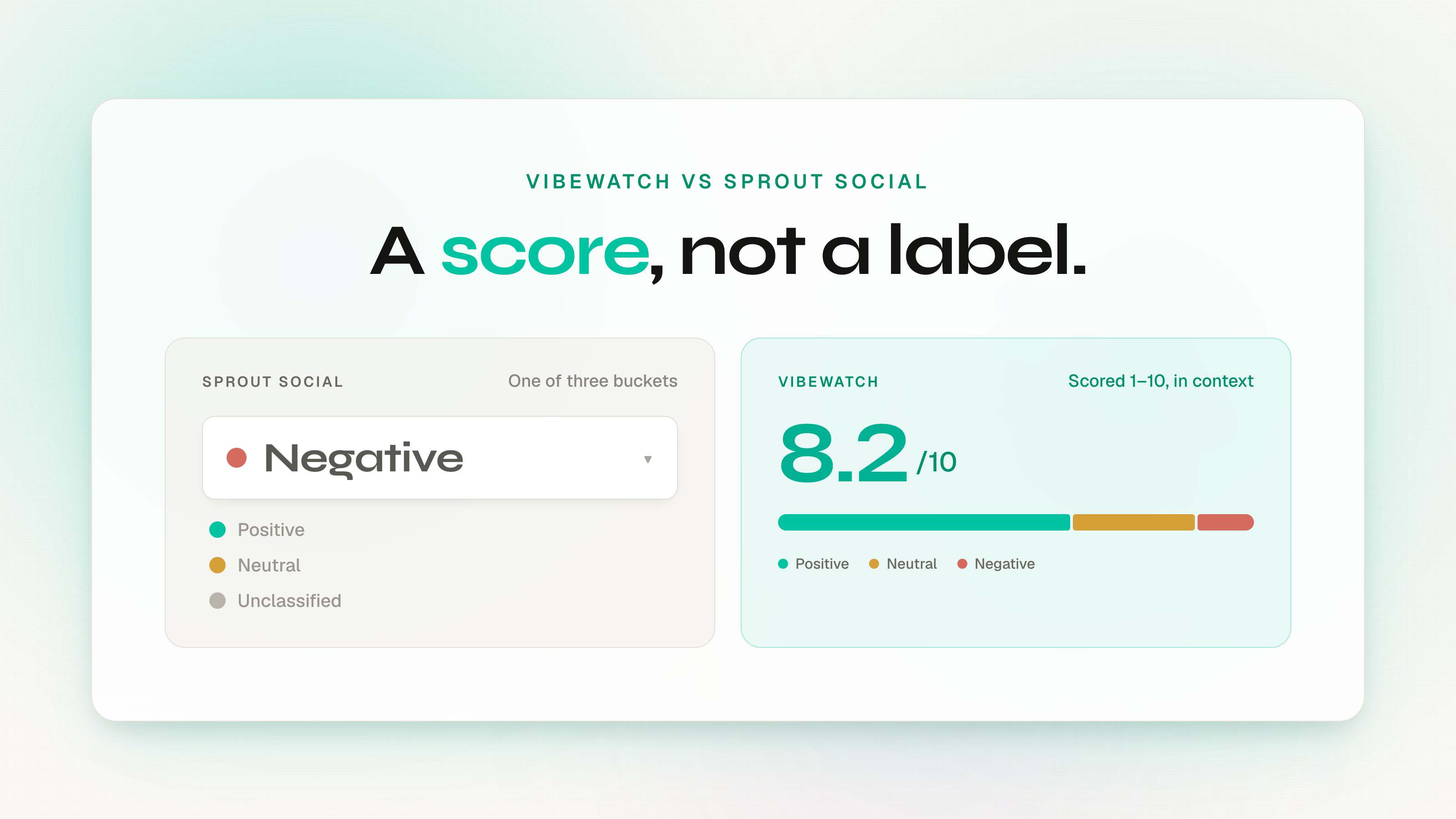
| Sentiment model | Context-aware, brand-calibrated, scored 1–10 | DNN label: Positive / Negative / Neutral / Unclassified |
| Channels | Discord, Telegram, X, YouTube, Bluesky, Farcaster, Lens, Nostr, Discourse, Snapshot, GitHub Discussions, Reddit (chosen subreddits) | X, Facebook, Instagram, Reddit, YouTube, TikTok, Tumblr, Bluesky, Web |
| Discord & Telegram (in-server bot) | Yes | No |
| Listening included? | Yes, it's the whole product | No, separate paid add-on |
| Team routing | Yes (pricing → growth, bugs → product) | Manual, via the inbox |
| Delivery | Weekly report to Slack, email, Notion | Log into the platform |
| Setup | Minutes, self-serve | Onboarding, usually team-led |
| Free trial | 7-day, no card | 30-day, no card |
| Pricing | $19–249/mo, seats included | $199/seat/mo (listening costs extra) |
Where Sprout Social wins: publishing and engagement
Sprout Social is good at a real, hard job.
For publishing and engagement, it's one of the strongest platforms on the market. You can plan and schedule content across every major network, run it through approval workflows, and manage every incoming comment, mention, and DM from a single Smart Inbox so a care team never loses a thread. Its analytics across the big public networks are mature and well regarded, and it's an official Reddit Data Partner with deep, sanctioned access to Reddit conversation. The company is public (NASDAQ: SPT) with years of product behind it.
If your job is running a brand's social presence, coordinating a marketing or customer-care team, and reporting on reach and engagement across the major networks, Sprout is a strong choice, and I'd recommend it for that. The rest of this article is about the one piece where I wouldn't reach for Sprout: listening on community channels.
Where Vibewatch wins: listening on community channels
Vibewatch is built for a different person: the one whose job is the community itself.
You're not scheduling posts or staffing an inbox. You're trying to keep a pulse on a Discord, a Telegram group, an X feed. Are people frustrated this week? Did the launch land? Is sentiment quietly sliding before anyone churns? What are the three things you should actually do something about? That's not a publishing question, and it isn't what a social management suite is shaped to answer.
So Vibewatch reads your community across every channel, scores each message, and writes you a narrative report: here's what your community said this week, what's trending up, what's down, what needs your attention. It lands in Slack, email, or Notion. You preview and approve it before it goes out, and you can ask it questions directly from Claude or ChatGPT over MCP.
It also reaches places Sprout's listening doesn't go at all. Your Discord servers, Telegram groups, Farcaster, Lens, Nostr, Bluesky, Snapshot, Discourse forums, GitHub Discussions. For a lot of communities, that's exactly where the real conversation happens.
Does Sprout Social monitor Discord or Telegram?
No. Neither Discord nor Telegram is a Sprout Social listening source.
Sprout's own "Social Listening data availability" documentation lists the networks its listening tool can pull from: X, Facebook (public Pages only), Instagram, YouTube, Tumblr, Reddit, TikTok, Bluesky, and the open Web (blogs, forums, news articles). Discord and Telegram appear nowhere in that list, and there's no community-channel category at all. Sprout listens to public social networks, not to the servers and group chats where most communities actually live.
The networks Sprout does cover have gaps of their own — the listening is narrower than "we monitor X platform" suggests:
- Instagram listening covers posts that include specific hashtags. Comments are not included.
- YouTube listening covers video descriptions. Comments are not included.
- The Web is checked once a day, and any post over 10kb is dropped.
- X data is sampled, not complete.
For a brand tracking hashtag campaigns across public social, that's a reasonable footprint. For a community manager who needs to know what's being said inside a Discord or a Telegram group, none of it reaches the conversation. Vibewatch joins those channels as a read-only bot and treats them as first-class sources, comments and all.
Is Sprout Social listening included, or is it an add-on?
It's an add-on. Sprout's listening documentation states it plainly at the top of the page: "This feature is only available for Social Listening customers."
Social Listening is not bundled into any base plan. It's one of several premium modules (alongside Premium Analytics and Employee Advocacy) that are sold separately, and Sprout doesn't publish a price for any of them. You request a quote. Social Champ's pricing breakdown — a third-party estimate Sprout has never confirmed — puts the Listening add-on at roughly $999–2,000 a month, on top of your seats.
That matters because the base platform is already per-seat. To reach Sprout's listening, you're buying a social management suite and then adding a quote-only module on top. Vibewatch's listening isn't a module. It's the whole product, on a published plan, with seats included rather than billed per head.
How does Sprout Social's sentiment analysis work?
Sprout's sentiment runs on a Deep Neural Network. For each message, the model weighs which words matter most, computes a probability across three categories, and assigns the highest one. The output is a label: Positive, Negative, or Neutral, plus Unclassified when the model can't decide.
A label has no intensity. A message is one of three buckets. "A bit annoyed the docs are out of date" and "I'm done, canceling, and telling everyone why" both land as Negative. The label tells you the direction, not the temperature, and for a community manager the temperature is usually the point.
The model also leans on word polarity, which means it stumbles exactly where context matters. Sprout's own documentation is candid about this. Its flagship example is a game publisher whose title, "War Zone," gets scored overwhelmingly negative because the words "war zone" read as negative on their own. Sarcasm is conceded as an open problem ("Sarcasm remains a challenge"). And the docs list this as a standing reason messages come back wrong or unscored:
Lack of Context: The AI may lack the necessary context to understand the sentiment of certain brand names, product names, or industry-specific terms.
That's Sprout naming the exact failure a brand-aware tool exists to solve. On top of it, messages that are media-only, in an unsupported language, or mixed in sentiment fall out as Unclassified, so a chunk of your conversation simply isn't scored.
Vibewatch approaches the same problem from a different generation of technology. Instead of a word-weight classifier, it reads each message in context: the channel it came from, the thread around it, and what your brand actually is. It scores both sentiment and relevance on a 1–10 scale, with reasoning, so you get intensity rather than a bucket. A brand name that collides with a negative word is the kind of thing a model that knows your brand handles on its own, without anyone hand-typing an exception. (Here's how Vibewatch contextualizes every message before it assigns a score.)
Can you correct Sprout Social's sentiment when it's wrong?
You can, but only by hand, and the corrections don't teach the engine anything — which shapes what your week actually looks like.
Sprout gives you two levers, both documented in its "Listening Rulesets & Sentiment" materials:
Sentiment Reclassification. You open a message and pick the correct label from a dropdown, or select up to 1,000 messages and stamp them in bulk. Sprout's own job aid scopes this to "Topics that are smaller and don't contain thousands of messages," so it isn't built for volume. Corrections are specific to one Listening Topic and do not carry over to others, there's no history or audit log of what you changed, and the fix updates the chart you're looking at, not the model's future behavior.
Sentiment Rulesets. This is a single, account-wide keyword dictionary. You type words and short phrases into Positive, Neutral, and Negative fields, and the classifier weights them accordingly. The documented limits are strict: you get one ruleset for the entire account (Sprout removed support for multiple), the system doesn't recognize word variations (you have to enter "win," "winning," and "wins" separately), a given keyword can live in only one category, and changes apply only to new data going forward.
Reclassification fixes the message in front of you and nothing else. It does not teach the classifier your brand, so the next message that makes the same mistake comes in misclassified again, and you correct it again. Rulesets blunt that only for exact keyword strings you've anticipated and typed in by hand. Anything contextual (sarcasm, a new product name, an inside joke that reads as negative) keeps recurring. Correcting Sprout is janitorial work, not teaching.
Vibewatch's correction loop is built to do the opposite. When you adjust a score, that correction becomes a worked example for the next scoring pass, and Vibewatch periodically distills your accumulated corrections into qualitative rules for your specific community. The goal is that Vibewatch stops making a class of mistake, instead of asking you to catch it forever.
The hand-typed dictionary has a Vibewatch counterpart too, and it fills itself in. Where Sprout asks you to enter "win," "winning," and "wins" as three separate entries, Vibewatch's exclusion keywords are mined: it maps the entities that collide with your brand term before the first sync, then watches for terms that recur in irrelevant matches and adds them on its own — with guardrails so it never excludes your own search terms.
Sprout Social pricing vs Vibewatch pricing
Sprout Social is priced per seat, billed annually. The published tiers are Essentials (around $79–99/seat/mo, which doesn't include listening), Standard at $199, Professional at $299, and Advanced at $399, with Enterprise quoted custom. Every teammate you add is another full seat at the same rate, and Social Listening is a separate add-on on top of all of it. There's a 30-day free trial with no card.
Vibewatch publishes three flat plans. Most teams land on Core ($99/mo: 60,000 messages, unlimited integrations, 3 seats, brand-keyword monitoring, 1-hour sync) or Pro ($249/mo: 150,000 messages, unlimited seats, 15-minute sync), with Lite ($19/mo: 5,000 messages, 3 integrations, 1 seat, weekly reports) for a single small community. Every tier reads every platform, seats are included rather than billed individually, you sign up without a sales call, and each plan includes a 7-day free trial with no credit card.
Vibewatch's top plan, with unlimited seats, runs less than a single Sprout Professional seat, before you've added Sprout's quote-only listening module at all. With Sprout you're buying a per-seat management suite and then adding that module to get the part that competes with Vibewatch. If sentiment reporting on your community is the actual job, that's a lot of platform to buy to reach it.
The cost structure, before you commit
Three things about Sprout's structure show up in any budgeting exercise:
- Per-seat cost adds up fast. Because pricing is per seat per month, a team of any size becomes a real annual number.
- Listening is priced separately and opaquely. The add-on modules require a sales conversation, and there's no public price to budget against.
- It's a lot of tool for a narrow need. If all you want is a read on sentiment, you're buying the full management suite to get it.
None of this makes Sprout a bad product. It's aimed at teams that need the full management suite and will use it daily. It just underlines the split: Sprout is a marketing and care platform, and listening rides on top, while Vibewatch is a lightweight sentiment report for the person running the community.
Is Vibewatch a good Sprout Social alternative?
- Sprout Social for publishing and engagement. If you're a social marketing or customer-care team that needs publishing, scheduling, a shared inbox, approval workflows, and analytics across the major public networks, and you'll use that suite every day, it's a strong, mature platform and the right pick.
- Vibewatch for listening on community channels. If you're running a community and you want to understand it, you get a narrative weekly report, sentiment scored 1–10 and calibrated to your brand, covering your Discord and Telegram servers plus the channels Sprout's listening never touches, self-serve, without per-seat billing.
- Keep Sprout for managing your public presence if you have that need. But when the job is reading your community, Sprout Listening is a quote-only add-on that misses your channels, and a purpose-built listening tool does the job better at a fraction of the price.
So Vibewatch is a good Sprout Social alternative when the part of Sprout you were buying is the listening, and your conversation lives on community channels. It isn't trying to replace the publishing suite, and if that's what you need, Sprout stays the natural fit.
If you're weighing community-sentiment tools more broadly, the same questions sort out Vibewatch vs Common Room (a go-to-market platform, not a sentiment report) and Vibewatch vs Octolens (a public-web mention tracker).
Frequently asked questions
Does Sprout Social monitor Discord or Telegram? No. Neither Discord nor Telegram is a Sprout Social listening source. Sprout's listening covers public networks (X, Facebook Pages, Instagram, YouTube, Tumblr, Reddit, TikTok, Bluesky) and the open Web, with no community-channel support. Vibewatch reads your Discord servers and Telegram groups as first-class sources.
Is Sprout Social's listening included in the price? No. Social Listening is a separate, quote-only add-on that sits on top of Sprout's per-seat base plans, not a bundled feature. Sprout's docs note the feature "is only available for Social Listening customers." Vibewatch's listening is the whole product, on a published plan, not a per-seat module.
Can you correct Sprout Social's sentiment if it's wrong? You can, but only by hand, and it doesn't teach the model. You can relabel individual messages (or up to 1,000 in bulk) within a single Listening Topic, or maintain one account-wide keyword ruleset. Neither carries learning forward, so the same misclassification recurs on new messages. Vibewatch's corrections feed the next scoring pass and distill into per-brand rules.
How does Sprout Social's sentiment analysis work? Sprout uses a Deep Neural Network that labels each message Positive, Negative, Neutral, or Unclassified. It's a categorical label with no intensity score, and Sprout's docs concede it can miss context around brand names, product names, sarcasm, and jargon. Vibewatch scores every message 1–10 for sentiment and relevance, in context, with reasoning.
What's the cheapest Sprout Social alternative for community sentiment? Vibewatch starts at $19/mo, self-serve, versus Sprout's $199-and-up per-seat plans plus a separate listening add-on. Seats are included in the Vibewatch plan rather than billed individually.
Is Sprout Social a listening tool or a publishing tool? Primarily a social media management and publishing platform, with a unified engagement inbox and analytics for marketing and care teams. Social Listening exists as a premium add-on, but the core product is built around managing a brand's public social presence.
Sprout Listening is a quote-only add-on on top of $199-per-seat plans, and it misses your community channels. Start a free Vibewatch trial at $19/mo with seats included, and the report covers your Discord servers and Telegram groups.