
Pricing and features verified against each product's own documentation.
Octolens and Vibewatch both promise to tell you what people are saying about you. They both score sentiment. They both filter noise with AI. But they're built for two different jobs, split by where your community actually lives.
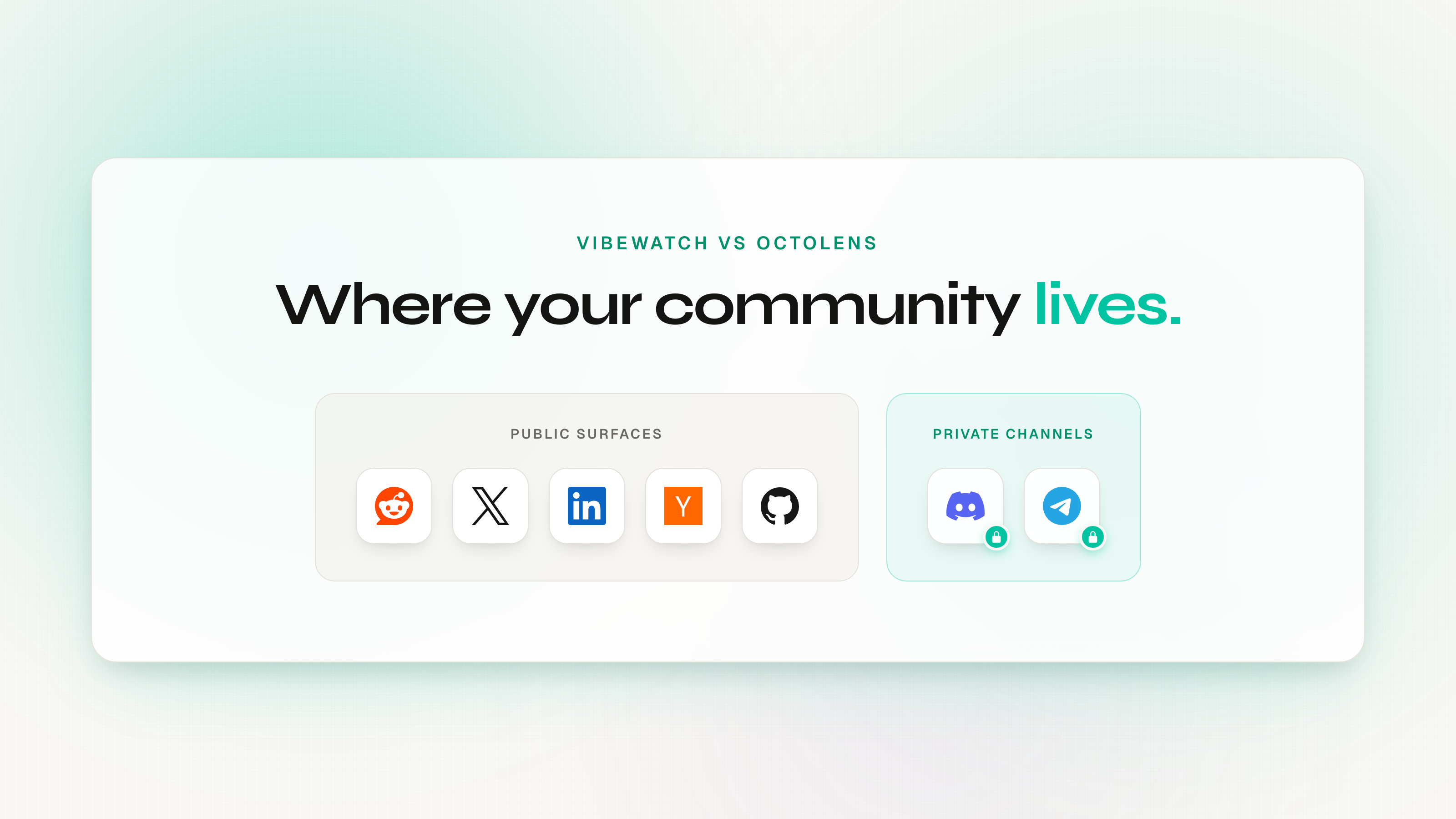
If your community talks in public — Reddit threads, Hacker News, X, GitHub issues — Octolens is built for exactly that. If it talks inside a Discord server or a Telegram group, Octolens can't see it at all. That's simply not the job they built for, and it's the reason Vibewatch exists.
So if you're shopping for an Octolens alternative, especially because your community lives somewhere Octolens can't reach, here's a comparison built from their own docs.
TL;DR
- Pick Octolens if you're a B2B SaaS or dev-tool team and your mentions happen on public surfaces like Reddit, X, LinkedIn, GitHub, Hacker News, Stack Overflow, and DEV. You want a real-time stream of individual mentions to reply to, tagged by intent. It's a lead-gen and brand-monitoring engine.
- Pick Vibewatch if your community lives inside your Discord and Telegram servers, and you want a narrative weekly report ("here's what your community said this week") instead of a stream of alerts to triage. Sentiment is calibrated to your brand and learns from your corrections.
- The split is structural, not cosmetic. Octolens doesn't monitor Discord or Telegram as sources. It only routes alerts out to Discord. Vibewatch starts at $19/mo, Octolens at $199/mo ($159/mo billed annually). They can coexist.
At a glance
If you're weighing Vibewatch as an Octolens alternative, these are the rows that actually decide it:
| Vibewatch | Octolens | |
|---|---|---|
| Built for | Community & web3 teams | B2B SaaS & developer-tool teams |
| Primary job | Narrative sentiment reporting | Brand-mention monitoring / lead-gen |
| Core output | Weekly narrative report | Real-time mention stream (+ weekly AI summary) |
| Sentiment | 1–10 per message, brand-calibrated | Positive / Neutral / Negative per mention |
| Relevance | 1–10, dual-axis | High / Medium / Low |
| Discord (in-server bot) | Yes | No |
| Telegram (in-server bot) | Yes | No |
| Channels | Discord, Telegram, X, Bluesky, Discourse, Farcaster, Lens, Nostr, Snapshot, GitHub Discussions, YouTube, Reddit (chosen subreddits) | Reddit, X, LinkedIn, HN, GitHub, Stack Overflow, DEV, YouTube, Bluesky, TikTok, podcasts, news, newsletters |
| Learns your community | Correction feedback loop + exclusion-keyword learning | Company Context (set once) |
| Delivery | Slack, email, Notion | Slack, email, webhook, REST API |
| Sync cadence | 3h / 1h / 15min by plan | Hourly (Pro) / real-time (Scale) |
| Data retention | 30 days / 7 months / 13 months by plan | 2 years (Pro) / unlimited (Scale) |
| Team seats | 1 / 3 / unlimited by plan | Unlimited on every plan |
| Free trial | 7-day, no card | 7-day, no card |
| Starting price | $19/mo | $199/mo ($159/mo annual) |
Where Octolens fits
Octolens calls itself "Social Listening Built for Developers," and that's an honest description. It's aimed at founders, growth teams, and DevRel at B2B SaaS and dev-tool companies, the kind of brand that gets talked about on Hacker News, in Reddit threads, on Stack Overflow, and across X and LinkedIn.
The product watches 13+ public platforms and surfaces every mention as it happens. An AI relevance pass grades each one (High / Medium / Low) against the context you give it, so every stray keyword match doesn't reach you. It tags mentions by intent (feature request, bug report, competitor mention) so you can route the right ones to the right people. And it pushes those mentions out in near-real-time to Slack, email, or a webhook.
If your growth motion is "find people asking about tools like ours and show up in the conversation," that's a good fit. Octolens is a lead-gen and brand-monitoring engine for teams whose audience is out in the open.
Where Vibewatch is different
Vibewatch is built for the part of your community that isn't in the open.
For a lot of teams, especially in web3, the real conversation doesn't happen on Reddit or Hacker News. It happens inside your Discord server and a couple of Telegram groups. That's where people report bugs, vent about gas fees, hype a launch, and quietly start drifting before they churn. A public-web listening tool sees none of it.
Vibewatch joins those channels as a bot, with permission, and reads what's actually being said. It also covers the public surfaces (X, Bluesky, Discourse forums) plus the web3-native ones most tools ignore: Farcaster, Lens, Nostr, Snapshot, GitHub Discussions, and YouTube comments. Then, instead of handing you a stream of alerts to triage, it writes you a report.
That's the other half of the difference. Octolens's unit of output is the individual mention. Vibewatch's is the narrative: a weekly read on what your community said, what's trending up, what's trending down, and what to do about it.
Sentiment analysis: Octolens vs Vibewatch
Octolens scores each mention as Positive, Neutral, or Negative, with a High / Medium / Low relevance band. Its docs are explicit that sentiment is "a three-value classification system, not a numeric score." You improve accuracy by filling in your Company Context once, up front. It's a clean, coarse signal, good enough to sort a stream and decide what's worth a reply.
Vibewatch scores every message on a 1–10 scale for both sentiment and relevance, calibrated to your brand. And it keeps learning: when you correct a score in the dashboard, that correction becomes a worked example for the next scoring pass, and Vibewatch periodically distills your accumulated corrections into qualitative rules for your community. (For the longer version, here's how Vibewatch contextualizes every message before it ever assigns a score.) It also spots recurring noise on its own, like ticker collisions, spam patterns, and off-topic chatter, and filters it before it touches your report.
Octolens gives you a fast three-bucket label, set once. Vibewatch gives you a granular score that bends toward how you read your community over time.
Does Octolens monitor Discord or Telegram?
No. Octolens monitors public-web platforms only and does not read Discord or Telegram as sources. Discord shows up in the product solely as a destination, somewhere you can route alerts via webhook. There's no bot-in-server access.
Octolens covers a lot of ground on public surfaces, and on the developer-marketing axis (Stack Overflow, DEV, Hacker News, LinkedIn, podcasts, newsletters) it covers more than Vibewatch does. If those are where your brand gets discussed, that breadth is real and useful.
Where it stops is inside the servers. With no bot-in-server access, there's no reading what's actually said inside your community. Octolens's own platform overview notes they're "working on adding more data sources," which is to say: not these, not yet.
Vibewatch is built around exactly that gap. Bot-level access to your Discord and Telegram servers is the core of the product, not a roadmap item. So if your community lives inside your Discord server, the choice isn't which tool does Discord better — Vibewatch can see it and Octolens can't.
Mention alerts vs a narrative report
Octolens is built for respond to mentions as they happen. Mentions stream into Slack, email, or a webhook in near-real-time (hourly on the Pro plan, instant on Scale). There's also a weekly AI summary digest if you'd rather get the highlights in one shot, but the center of gravity is the live stream of individual mentions.
Vibewatch is built for understand what your community said this week. The core deliverable is a narrative weekly report, delivered to Slack, email, or Notion. Before it goes out, you can preview and approve it, so what lands in your team's channel is something you've signed off on, not a raw feed. You can also connect it to Claude or ChatGPT over MCP to ask questions directly.
Same raw material, your community's conversation, shaped into two outputs for two jobs. Octolens wants you to act on each mention. Vibewatch wants you to understand the whole.
Octolens pricing vs Vibewatch pricing
Octolens starts at $199/mo (Pro: 15,000 mentions, 10 keywords, unlimited seats, hourly alerts), or $159/mo billed annually. Their pricing page defaults to the annual view, so the $159 you see first is the annual-billed rate, not the monthly price. Scale is $599/mo ($499/mo annual: 50,000 mentions, real-time alerts, podcasts/news/newsletters), with custom Enterprise above that. There's a 7-day free trial and no free tier. Extra mentions run $0.013 each on Pro, $0.01 on Scale.
Vibewatch starts at $19/mo (Lite: 5,000 messages, 3 integrations, 1 seat, every platform, weekly reports), with $99/mo Core (60,000 messages, unlimited integrations, 3 seats, brand-keyword monitoring, 1-hour sync) and $249/mo Pro (150,000 messages, unlimited seats, 15-minute sync). Every plan includes a 7-day free trial with no credit card.
The two quotas also measure different things. Vibewatch's message limit only counts signal — duplicates, retweets, bot noise, and anything matching its learned exclusion keywords are filtered out before they touch the quota — so a noisy week spends your allowance on messages worth reading, not on matches you'd never look at.
Both set up in minutes. The real difference is price: Vibewatch's entry plan is about a tenth of Octolens's, which matters a lot if you're a small team or a single community manager rather than a funded growth org.
Is Vibewatch a good Octolens alternative?
- Octolens if you're a B2B SaaS or dev-tool team and your mentions live on public surfaces like Reddit, X, LinkedIn, GitHub, and Hacker News. The real-time stream and intent tagging fit how product and DevRel teams actually work, and the public-web coverage is broad and real.
- Vibewatch if your community lives inside your Discord and Telegram servers (web3 especially), and you want a narrative weekly report, calibrated to your brand and learning from your corrections, instead of a stream of alerts to triage. Starting at $19/mo.
- They can coexist. Octolens for public dev-surface monitoring and lead-gen, Vibewatch for sentiment inside the community. They're not really competing for the same job. They cover two halves of where people talk about you.
So: a good Octolens alternative if the part of your community you most need to understand is happening in channels Octolens structurally can't see. If it's all out in the open, Octolens is the more natural fit.
Frequently asked questions
Does Octolens monitor Discord or Telegram? No. Octolens monitors public-web platforms only and does not read Discord or Telegram as sources. Discord appears solely as a destination you can route alerts to via webhook. Vibewatch joins your Discord and Telegram servers as a bot and reads what's actually said inside them.
What's the cheapest Octolens alternative? Vibewatch starts at $19/mo, versus Octolens's entry plan at $199/mo ($159/mo billed annually) — about a tenth of the price. Both offer a 7-day free trial with no credit card required.
Does Octolens have a free plan? No. Octolens offers a 7-day free trial capped at 1,000 mentions, but no permanent free tier. Vibewatch also runs a 7-day trial and delivers your first report on day three.
Does Octolens do sentiment analysis? Yes. Octolens labels each mention Positive, Neutral, or Negative, with a High / Medium / Low relevance band. Vibewatch scores every message 1–10 for both sentiment and relevance, and learns from your corrections over time.
Is Octolens or Vibewatch better for a web3 community? Vibewatch, in most cases. It covers your Discord and Telegram servers plus web3-native sources like Farcaster, Lens, Nostr, and Snapshot that Octolens doesn't monitor. Octolens is the stronger pick for public B2B and dev-tool surfaces like Hacker News, Stack Overflow, and LinkedIn.
Octolens routes alerts into Discord but never reads it. Start a free Vibewatch trial at about a tenth of Octolens's $199/mo entry price and the bot reads your server and Telegram groups as sources.