
Pricing and features verified against Common Room's own documentation and pricing page.
Common Room and Vibewatch both read your community. They both ingest Discord. They both have a feature called sentiment. Search "Common Room alternative" and you'll land on a page like this expecting a feature-for-feature shootout.
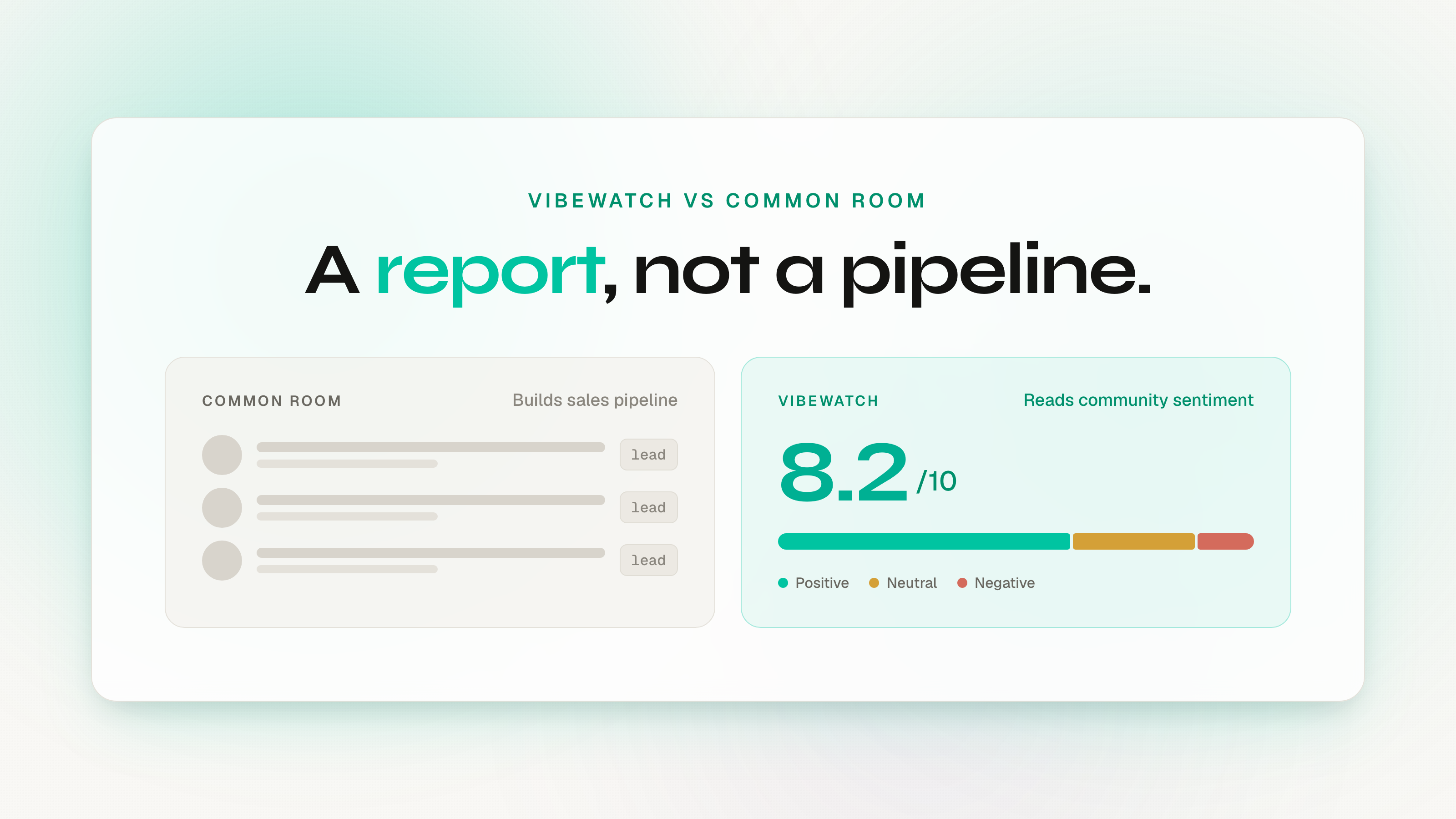
That's not really what this is, because the two products aren't doing the same job. Common Room started life as a community tool and has since become something much bigger and much more expensive: a go-to-market intelligence platform built for sales and revenue teams. It reads your community to find people to sell to. Vibewatch reads your community to tell you how it's doing.
That difference shows up everywhere, but nowhere louder than the price tag. Vibewatch starts at $19 a month, self-serve. Common Room's entry plan is $2,500 a month, billed annually, after a sales demo. They're not competing for the same budget, the same buyer, or the same problem.
So if you came here shopping for a Common Room alternative, choose by the job you're hiring for. Here's a comparison built from their own docs.
TL;DR
- Pick Common Room if you're a RevOps, sales, or growth team at a funded B2B company and your goal is pipeline: turn community and social activity into enriched contacts, score them for buying intent, and push them into Salesforce and your outbound tools.
- Pick Vibewatch if you're the person running the community and you want to know how it feels, not who to sell to. You get a narrative weekly report ("here's what your community said this week"), with sentiment scored 1–10 and calibrated to your brand. From $19/mo, self-serve, with an accessible demo.
- It's a category difference, not a feature gap. Common Room is a ~$30k/yr sales-intelligence platform. Vibewatch is a ~$228/yr sentiment-reporting tool. They overlap on a few logos in the integration list and almost nothing else.
At a glance
If you're weighing Vibewatch as a Common Room alternative, these are the rows that actually decide it:
| Vibewatch | Common Room | |
|---|---|---|
| Built for | Community managers | RevOps, sales & growth teams |
| Primary job | Narrative sentiment reporting | Go-to-market signal capture / pipeline |
| Core output | Weekly narrative report | Queryable signal platform + member CRM |
| Sentiment | 1–10 per message, brand-calibrated | Positive / Negative activity tag (English-primary) |
| Headline AI | Context-aware scoring & reporting | RoomieAI — outbound sales agents |
| Channels (as sources) | Discord, Telegram, X, Bluesky, Farcaster, Lens, Nostr, Snapshot, Discourse, GitHub Discussions, YouTube, Reddit (chosen subreddits) | Discord, Slack, X, Reddit, GitHub, LinkedIn, YouTube |
| Telegram (in-server bot) | Yes | No |
| Web3-native sources | Yes | No |
| Learns your community | Correction loop, calibrated to your brand | Sentiment edits improve a shared model |
| Delivery | Weekly report to Slack, email, Notion | Log into the platform; sync to CRM / sales tools |
| Setup | Minutes, self-serve | Ops-led rollout across 50+ integrations |
| How you buy it | Self-serve checkout, no call | Sales demo, annual contract |
| Free trial | 7-day, no card | No free tier; demo only |
| Starting price | $19/mo | $2,500/mo (billed annually) |
Where Common Room fits
Common Room is good at a hard, real job.
It auto-collects activity from 50-plus sources, including community channels like Discord and Slack, social like X, Reddit, and LinkedIn, plus your product usage, CRM, and website. Then it resolves all of that into people — the job it's built for. Its Person360 enrichment stitches a username in your Discord to a real person at a real company, scores them for buying intent using firmographics and behavior, and pushes the high scorers into Salesforce, HubSpot, Outreach, or Apollo so a rep can follow up.
The headline AI, RoomieAI, is a suite of sales agents along the same lines: research a prospect, surface who's ready for outreach, draft personalized outbound. There's a 200-million-contact prospecting database underneath. The whole platform is organized around one idea Common Room calls illuminating the "Dark Funnel": catch buying signals wherever they happen and turn them into pipeline.
If your motion is community-led growth that needs to show up as revenue, and you have the team and budget to run it, Common Room is a strong choice. That's the buyer it's built for: RevOps, sales development, and demand gen at a funded company.
Where Vibewatch is different
Vibewatch is built for a different person entirely: the one whose job is the community itself.
You're not trying to extract leads from your Discord. You're trying to keep a pulse on it. Are people frustrated this week? Did the launch land? Is sentiment quietly sliding before anyone churns? What are the three things you should actually do something about? That's not a pipeline question, and it's not what a sales-intelligence platform is shaped to answer.
So Vibewatch does the opposite of "log in and dig through dashboards." It reads your community across every channel, scores each message, and writes you a narrative report: here's what your community said this week, what's trending up, what's down, and what needs your attention. It lands in Slack, email, or Notion. You can preview and approve it before it goes out. You can also ask it questions directly from Claude or ChatGPT over MCP.
It also reaches places Common Room doesn't. Your Telegram groups. Farcaster, Lens, Nostr, Bluesky, Snapshot, Discourse forums, GitHub Discussions, YouTube comments. For a lot of communities, especially in web3, that's where the real conversation happens, and a GTM platform aimed at B2B sales has no reason to go there.
Does Common Room monitor Discord and Telegram?
Discord: yes. Common Room reads Discord properly, including private channels within a server (there's no public/private Discord server distinction — a bot reads the channels it's added to). It imports messages, threaded replies, and reactions from the channels you select. It reads Slack communities too. On that front it's a real integration, not a webhook.
Telegram: no. Telegram isn't a native Common Room source. You'd have to wire it up yourself through Zapier or a custom integration. Vibewatch joins Telegram groups as a bot and reads them as a first-class source.
The reason matters more than the channel list. Common Room ingests your Discord to capture contacts and signals — to create a person record for every member and feed the pipeline engine. It is not reading your Discord to tell you how your community feels. The sentiment is a side feature (more on that next); the purpose is the member graph. Vibewatch reads the same Discord for the opposite reason: to understand the conversation, not to harvest the people in it.
So if someone asks "does Common Room do Discord," the accurate answer is yes — but for a sales workflow, not a sentiment one.
Common Room sentiment vs Vibewatch sentiment
Common Room does have sentiment analysis. It's just a minor feature, and it's built differently from what you might assume.
Common Room's docs describe a proprietary in-house machine-learning model that tags an activity as Positive or Negative when it's confident enough — a categorical label, not a numeric score. It's primarily trained for English. There's a feedback loop: when you correct a tag, it "helps improve Common Room's machine learning-powered sentiment algorithms" — but that improves the shared model over time, rather than calibrating a profile to your specific brand. And notably, sentiment isn't part of the headline AI at all: the RoomieAI product pages are about prospecting and outbound, with no mention of sentiment scoring.
Vibewatch scores every message on a 1–10 scale for both sentiment and relevance, calibrated to your brand. When you correct a score, that correction becomes a worked example for the next scoring pass, and Vibewatch periodically distills your accumulated corrections into qualitative rules for your community. (For the longer version, here's how Vibewatch contextualizes every message before it ever assigns a score.) It handles non-English conversation, and it filters recurring noise like ticker collisions and spam before any of it reaches your report.
Common Room gives you a coarse Positive/Negative tag as one filter among many in a sales platform. Vibewatch makes granular, brand-aware sentiment the entire point of the product.
A signal platform vs a narrative report
This is the structural split, and it's the clearest way to tell which tool you want.
Common Room is something you log into and query. The deliverable is the platform itself: signals aggregated from 50-plus channels, enriched Person360 profiles, segments, and buying-intent scores you act on by routing people into your CRM and sales tools. It's a system of record for go-to-market. Powerful, but it assumes someone whose job is to live in it.
Vibewatch is something that comes to you. The deliverable is a written weekly report, with daily highlights if you want, delivered to where your team already works. You don't have to go digging; the read on your community shows up in Slack on Monday morning. One is a data platform for analysts and reps. The other is a briefing for the person running the room.
Common Room pricing vs Vibewatch pricing
The "alternative" framing breaks down on price: the two tools aren't in the same universe.
Common Room has no free tier and no self-serve checkout. The entry plan, Essential, is $2,500/mo billed annually — $30,000 a year — for 5 seats and up to 100,000 contacts. The two tiers above it, Advanced and Enterprise, are custom-quoted and gated behind a "Request demo" button. That price only makes sense if you have enough community-driven pipeline to justify it.
Vibewatch starts at $19/mo (Lite: 5,000 messages, 3 integrations, 1 seat, every platform, weekly reports), with $99/mo Core (60,000 messages, unlimited integrations, 3 seats, brand-keyword monitoring, 1-hour sync) and $249/mo Pro (150,000 messages, unlimited seats, 15-minute sync). You sign up and start; there's no sales call, and every plan includes a 7-day free trial with no credit card.
Common Room's entry plan costs $30,000 a year — roughly ten times Vibewatch's top plan. If you're a community manager or a small team, that alone usually settles it.
What to know before you book a demo
- Setup is a project. Getting value means wiring up your integrations, intent scoring, and CRM routing across a 50-plus-source platform — ops work, not an afternoon toggle.
- Entry pricing keeps climbing. Common Room's published entry price moved from $1,000/mo to $1,700, then $2,100, then $2,500/mo across roughly eighteen months of its own pricing page. Budget for the trajectory, not just today's number.
- The buying process is enterprise-shaped. No free tier, no self-serve checkout — a sales demo, then an annual contract.
None of this means it's a bad product — it's aimed at teams equipped to absorb that complexity for the payoff in pipeline. It just underlines the point: this is heavy machinery for a sales org, not a lightweight reporting tool for a community lead.
A quick note on Common Room's direction
Common Room was founded in 2020 as a community-intelligence tool, which is why its name and some of its older positioning still sound community-flavored. But the company has openly pivoted: it now describes itself as a customer intelligence platform "built for GTM teams, by GTM teams," and popularized the idea of "signal-based selling." Its integrations, its AI, its pricing, and its buyer have all moved toward sales.
That's a perfectly reasonable business move. It just means that if you arrived because you remember Common Room as a community tool, the product you'll actually be sold today is a go-to-market platform — worth knowing going in.
Is Vibewatch a good Common Room alternative?
- Common Room if you're a RevOps, sales, or growth team chasing pipeline, you want enrichment, intent scoring, CRM and outbound sync, and prospecting, and you have the budget (~$30k/yr and up) and an ops person to run it. For that job it's a strong, mature platform.
- Vibewatch if you're running a community and you want to understand it: a narrative weekly report, sentiment scored 1–10 and calibrated to your brand, covering your Discord and Telegram servers plus web3-native channels — self-serve from $19/mo.
- They barely overlap. Common Room turns your community into leads. Vibewatch turns it into a report you can act on as its steward. If you're not trying to build a sales pipeline out of your members, you almost certainly don't need a sales-intelligence platform to read them.
So: a good Common Room alternative if what you actually want is community sentiment and reporting, without the six-figure platform wrapped around it. If your real goal is pipeline, Common Room is the more natural fit, and Vibewatch isn't trying to do that job.
Frequently asked questions
Does Common Room monitor Discord and Telegram? Discord, yes — including private channels within a server, importing messages, replies, and reactions. Telegram, no; it's not a native source and would need a custom or Zapier workaround. Common Room reads Discord to capture contacts for sales pipeline, though, not to score how your community feels. Vibewatch reads both Discord and Telegram as first-class sources, for sentiment.
What's the cheapest Common Room alternative? Vibewatch starts at $19/mo, self-serve, versus Common Room's entry plan at $2,500/mo billed annually — about $30,000 a year, roughly ten times Vibewatch's top plan.
Does Common Room have a free plan? No. Common Room has no free tier and no self-serve trial; you go through a sales demo, and the entry plan is an annual contract. Vibewatch offers a 7-day free trial with no credit card, and delivers your first report on day three.
Does Common Room do sentiment analysis? Yes, but it's a minor feature: a proprietary model that tags activity as Positive or Negative (a categorical label, primarily trained for English), separate from its headline sales AI. Vibewatch scores every message 1–10 for sentiment and relevance, calibrated to your brand, and learns from your corrections.
Is Common Room a community tool or a sales tool? It began as a community-intelligence product in 2020 but has pivoted to a go-to-market intelligence platform built for sales, RevOps, and growth teams. Sentiment and community monitoring still exist, but the product is now organized around turning activity into pipeline.
Common Room's entry plan is $2,500/mo on an annual contract, sold through a demo. Start a free Vibewatch trial self-serve and the first report covers the Telegram groups Common Room can't read.