
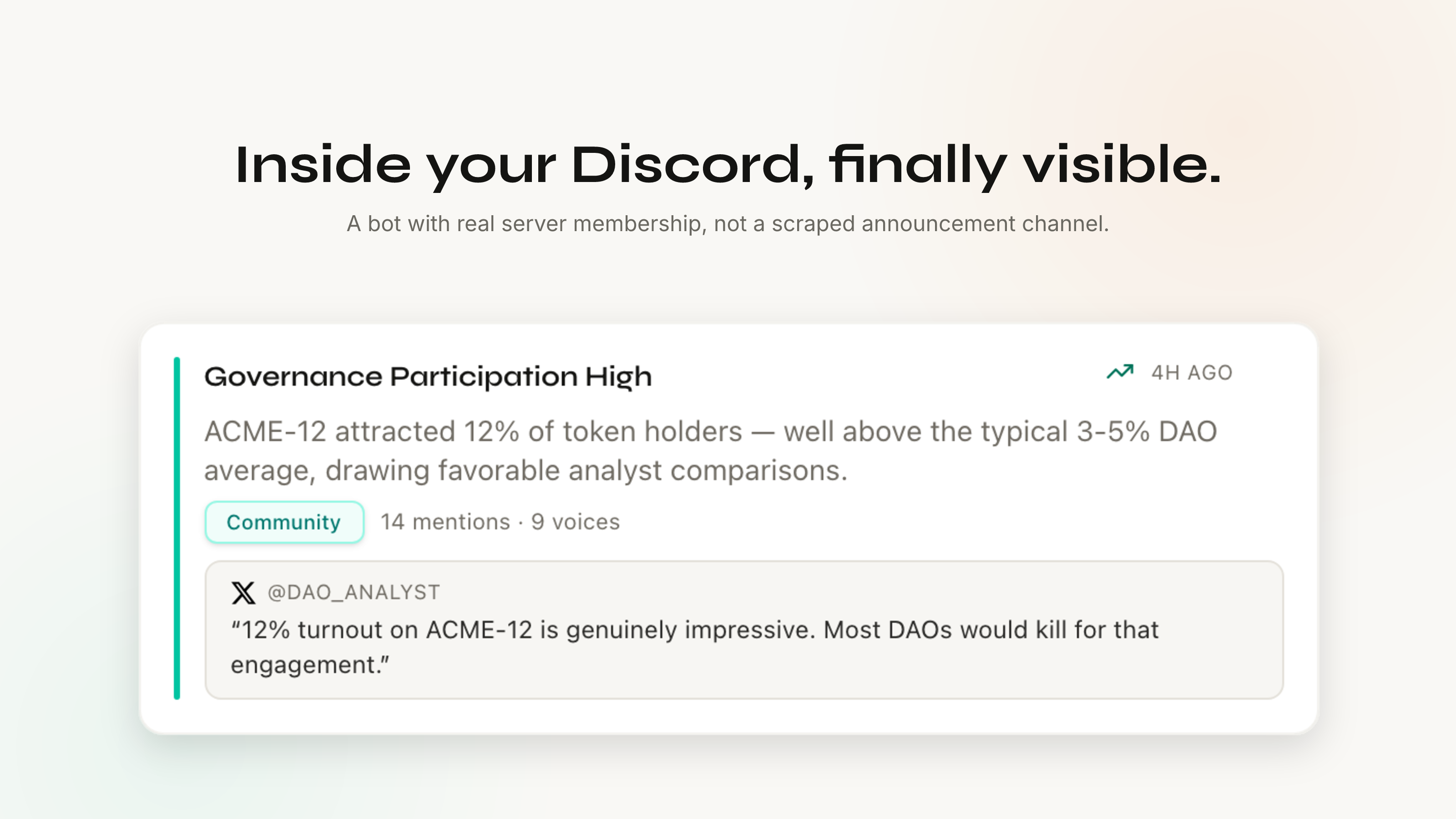
Type your project's name into almost any social-listening tool and it will happily show you every mention on X, every Reddit thread, every news article. Ask it what's being said on Discord, and it comes back empty. People are talking about you there; the tool structurally cannot see them.
Why Discord breaks normal brand monitoring
Every listening tool built for the open web works the same way underneath: crawl or query a public, indexed surface. X posts are public and searchable. Reddit threads are public and searchable. News and blogs get indexed by search engines. A tool built on that model can watch all of it without asking anyone's permission.
Discord isn't built that way. A server is a closed space — there's no public index of what's said inside one, and no search API that returns "every message mentioning [your project] across Discord." The only way to see a server's conversation is to actually be in it. That's true whether the watcher is a person or a bot, and no amount of crawling infrastructure changes it.
So when a listening tool claims Discord coverage, look closely at what it's actually reading. Most of the time it's a public-facing announcement channel someone pointed a scraper at — one-way broadcast, admin posts and everyone reads, no different from reading a blog post. That's the marketing copy about your project, not the conversation about it.
What actually works: membership, not search
Real Discord coverage means a bot with genuine server membership — invited in by an admin, the same way you'd invite any other bot, with read access to the channels where people actually talk to each other. That's an access grant, a first-class relationship Discord itself tracks. Pointing a scraper at a channel someone already made public isn't a grant of anything, because there was nothing to grant.
For your own reputation, that means two kinds of server matter:
- Your own community's server, where the conversation about your project is direct and most of it will genuinely be about you.
- Ecosystem and partner servers you already belong to — a broader DAO or protocol community, a launchpad, an accelerator cohort — where your project comes up alongside dozens of others and you need a way to actually notice when it does.
In the second case, most of what the bot reads has nothing to do with you. So every message gets a relevance score from 1 to 10 alongside its sentiment score — how related this message is to your project — and the report is built from the ones that are about you. The rest of the server's traffic stays out of it.
When your project's name means something else too
A plain keyword match breaks the moment your project's name overlaps with something else: a ticker symbol, a common word, another product shipping under a similar name. Boolean-search tools hand you the operator syntax and the tuning job with it — you write the query, you notice the noise, you edit the query, and you do it again every time a new collision turns up.
Vibewatch doesn't match your name against a string. Every message goes to the scoring model with the platform it came from, its author, the message it's replying to, and a description of what your project actually is. A conversation about a same-named stock ticker reads as a conversation about a stock ticker and scores low on relevance, so it never reaches the report. There's no query to write and nothing to re-tune.
When one gets scored wrong, correct it. Vibewatch derives a scoring rule from the correction rather than just overriding that single message, so the same class of mistake stops recurring instead of needing to be caught every time.
Setting it up
- Connect the servers that matter. Start with your first report free — your own community server first, that's the highest-signal source by far, then any ecosystem or partner servers you're already a member of.
- Choose the channels. Point the integration at a server and it discovers the channels the bot can read. On a large server, narrow it to the ones where people actually talk to each other.
- Let the first week run before judging it. Scoring calibrates on your project's own context and gets sharper as you correct it; day one won't read as cleanly as week two.
- Watch the weekly report, not a live feed. A narrative summary with citations to the actual messages catches a reputation problem forming days before a raw activity graph would show anything unusual — see how to measure Discord community health for the five signals that go into that read.
- Correct what's wrong. A misread mention isn't just fixed once — the correction becomes a worked example, and the system is less likely to repeat that specific mistake going forward. Full mechanism: how Vibewatch contextualizes every message.
Tools built on boolean search sell this differently. Agorapulse prices its Advanced Listening add-on per search query, and its documented sources stop at the edge of the public web either way — the Agorapulse comparison has the full breakdown.
Frequently asked questions
Can any tool monitor my brand's reputation on Discord without joining the server? No. Discord has no public index and no search API for arbitrary server content, so the only way to read a server's conversation — automated or not — is genuine membership. Anything claiming otherwise is reading a public announcement channel, not the discussion.
Is this different from monitoring my own community's health? Related but not the same job. Community health asks how your own server is doing overall. Reputation monitoring asks where your project is being talked about outside your own server — in ecosystem and partner communities you also belong to — and leans on relevance scoring to separate real mentions from everything else in the room.
Does this replace watching my own server manually? For your own server, no manual watching is required day-to-day — the weekly report is built for that. For other servers, someone still has to be a member for the bot to read anything; there's no way around Discord's membership model, for a bot or a person.
What if my project's name means something else too? Relevance is scored by reading the message, not by matching your name against a string. A conversation about a same-named ticker or product scores low because the conversation isn't about your project, and it stays out of the report. If one does get scored wrong, correcting it teaches a rule rather than fixing a single row.
Get your first report free — from $19/mo, no card required.