
Pricing and features verified against each product's own documentation.
Santiment and Vibewatch both analyze crypto sentiment. Both watch Telegram and X. Both put a number on how a community feels. Side by side on a feature list, they look like direct rivals.
They're answering two different questions. Santiment is built for the person asking "should I buy this coin?" Vibewatch is built for the team asking "what is our community saying?" Those questions share raw material — social chatter — but they lead to completely different products, and if you pick the one built for the other question, you'll feel it within a week.
So if you're evaluating a Santiment alternative — especially because you're the team running a project rather than trading one — here's a comparison built from their own docs.
TL;DR
- Pick Santiment if you're a trader, analyst, or researcher making market decisions. Its killer feature is on-chain data — whale activity, exchange flows, developer activity — correlated with social metrics, with historical depth back to 2016, custom screeners, and API access. Nobody in this comparison touches that.
- Pick Vibewatch if you run a project and need to know how your own community feels — inside your Discord and Telegram servers (via bot), across X and ten more platforms — with sentiment that learns from your corrections and a weekly narrative report your whole team reads. Starting at $19/mo.
- They do different jobs with the same raw material. Santiment reads public Telegram, X, and Reddit data for market-wide signals; it doesn't ingest Discord at all and can't join your servers. Vibewatch sits in the channels where your community actually talks. They can coexist on the same team.
At a glance
If you're weighing Vibewatch as a Santiment alternative, these are the rows that decide it:
| Vibewatch | Santiment | |
|---|---|---|
| Built for | Teams running a project (community, marketing, founders) | Traders, analysts, quant-minded researchers |
| Primary job | "How does our community feel?" | "Should I buy this coin?" |
| Core output | Weekly narrative report | Charts, metrics, screeners, API |
| On-chain data | No (token price context via CoinGecko) | Yes — whale activity, exchange flows, dev activity |
| Your Discord server (bot) | Yes | No — Discord isn't among its sources at all |
| Your Telegram groups (bot) | Yes | No — public Telegram data only |
| Sentiment model | 1–10 per message, calibrated to your brand, learns from corrections | Positive/negative, global model (generic public tweet dataset) |
| Channels | Discord, Telegram, X, Bluesky, Discourse, Farcaster, Lens, Nostr, Snapshot, GitHub Discussions, YouTube, Reddit (chosen subreddits) | X, Reddit, public Telegram chats, Bitcointalk, 4chan, YouTube transcripts, Farcaster + on-chain sources |
| Historical depth | 30 days / 7 months / 13 months by plan | Back to 2016 |
| Reports | Weekly narrative, delivered to Slack, email, or Notion | Monthly report + Pro Insights on paid plans; dashboard-first |
| Learning curve | Built for community managers | Built for analysts — steep by design |
| Free trial | 7-day, no card | Free tier (30-day data lag) |
| Starting price | $19/mo | $49/mo (Sanbase Pro) |
Where Santiment fits
Santiment is a crypto research platform, and a serious one. It combines social sentiment with on-chain analytics — whale movements, exchange inflows and outflows, developer activity — into one set of metrics you can chart, screen, and query. Historical data goes back to 2016. Social Trends surfaces the words and topics gaining momentum across crypto conversation. There's a Google Sheets plugin, custom screeners, and API access on higher tiers for anyone who wants to build on the data directly.
If your job is deciding what to buy, when to exit, or which narrative is about to run, that combination is hard to beat. On-chain data correlated with social sentiment is Santiment's home turf, and Vibewatch doesn't compete there at all — we include token price and market context in reports, but we don't do on-chain analysis.
The trade-off is who it's built for. Santiment's interface assumes an analyst's patience: you learn the metrics, build the charts, set up the screeners. That's a feature if you're quant-minded. It's a wall if you're a community manager who just needs to know whether last night's announcement landed.
Where Vibewatch is different
Vibewatch is built for the team on the other side of the chart — the people running the project the analysts are charting.
Your community's real conversation doesn't happen in aggregate social metrics. It happens inside your Discord server and your Telegram groups: the bug reports, the launch hype, the quiet frustration that shows up three weeks before the churn does. Santiment tracks public Telegram chats, X, and Reddit for market-wide trend detection — Discord isn't among its sources at all, and it can't join your servers. The channels where your community actually talks are invisible to it — structurally, not as a missing feature.
Vibewatch joins those channels as a bot, with your permission, and reads what's actually being said. It covers the public surfaces too — X, Bluesky, Discourse forums, YouTube comments — plus the web3-native platforms almost nothing else monitors: Farcaster, Lens, Nostr, Snapshot, and GitHub Discussions. Then, instead of handing you a dashboard to interpret, it writes you a weekly report: what your community talked about, what's trending up, what's trending down, and which members are worth highlighting — with citations linking back to the actual messages.
Sentiment analysis: Santiment vs Vibewatch
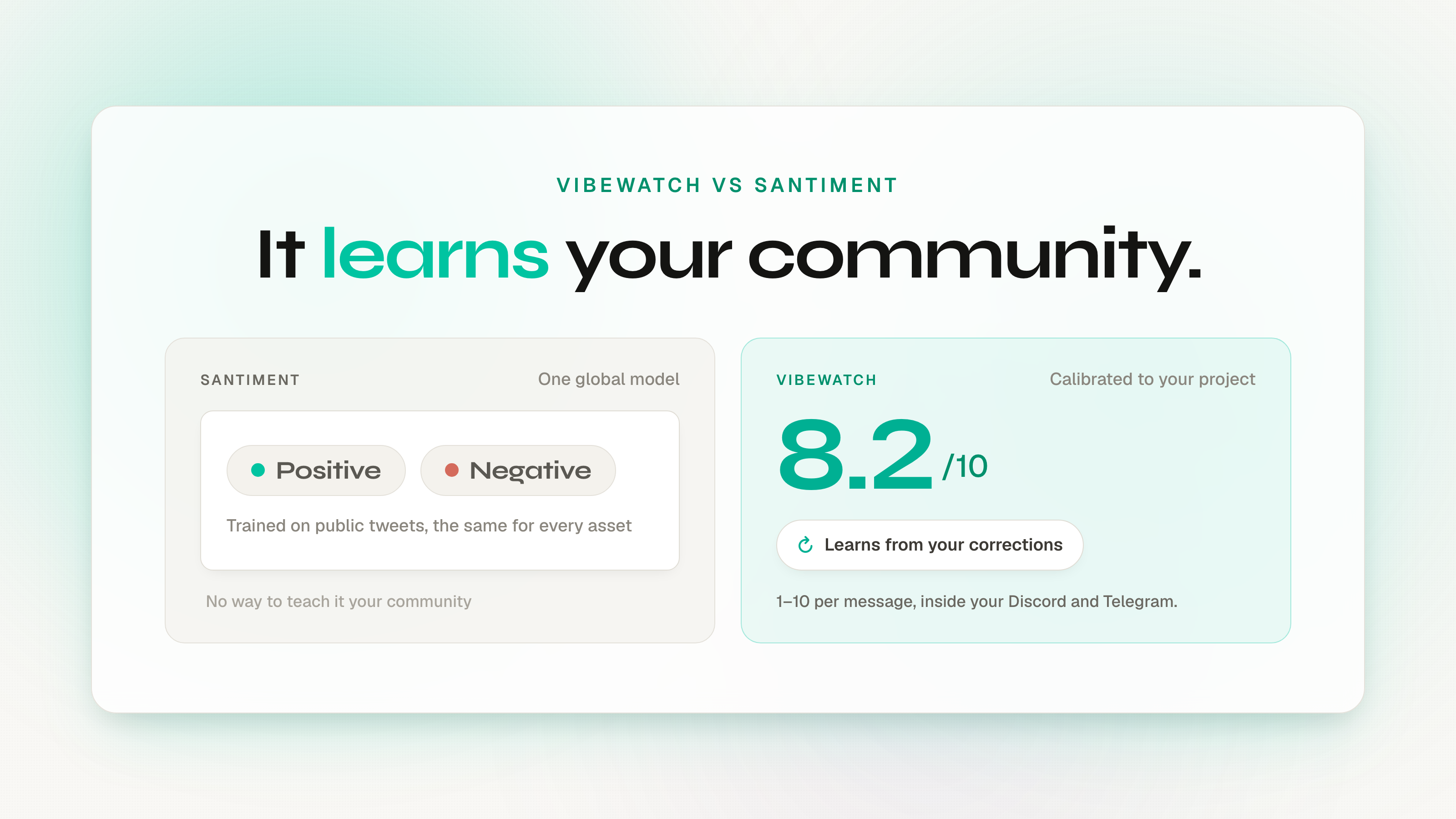
Santiment classifies sentiment as positive or negative using a global NLP model trained on a large public tweet dataset. That's the right design for its job: a market-wide signal needs to score every asset's chatter the same way, or the cross-asset comparisons break.
It's the wrong design for your community. A global model doesn't know that when your community says "lfg" it's celebrating, or that "mining" in your channels means GPUs, not the token with a similar ticker. And there's no way to teach it — Santiment has no mechanism for improving accuracy per organization.
Vibewatch scores every message 1–10 on both sentiment and relevance, calibrated to your brand. When you correct a score, that correction becomes a worked example for the next scoring pass, and over time your accumulated corrections get distilled into rules for your specific community. It also learns your recurring noise — ticker collisions, spam patterns, off-topic chatter — and filters it before it reaches your report.
One model measures the market. The other learns your community. Which one you need depends entirely on which question you're asking.
Does Santiment monitor your Discord and Telegram servers?
No. Santiment's documented social sources are public Telegram chats, X, Reddit, Bitcointalk, 4chan, YouTube transcripts, and Farcaster — Discord isn't ingested at all, and there is no bot you can invite. If the conversation you need to understand happens inside your own Discord and Telegram, Santiment can't see it — full stop.
Vibewatch is built around exactly that access. Bot-level presence in your Discord and Telegram servers is the core of the product, and every message there gets the same calibrated scoring as your public platforms, in one consistent view. For a project team, that usually covers the large majority of community conversation that no aggregate social metric will ever capture.
A dashboard for analysts vs a report for your team
Santiment's center of gravity is the dashboard: charts, screeners, alerts, and an API for pulling data into your own tooling. Written output exists — Pro Insights on paid plans: market reports, daily briefs on whale and trader behavior, and short-term trend analysis from the Santiment team — but it's market research, not an account of your community. The workflow assumes someone on your team logs in, reads the metrics, and translates them for everyone else.
Vibewatch inverts that. The core deliverable is a narrative weekly report — written analysis, not data tables — delivered to Slack, email, or Notion. You preview and approve it before it posts, so what lands in the team channel is signed off, not raw. Marketing sees how the campaign landed, engineering sees the bug frustration, leadership gets the summary — one report, no translator required. And if you'd rather interrogate the data directly, you can connect Claude or ChatGPT over MCP and ask questions in plain language.
Santiment pricing vs Vibewatch pricing
Santiment offers a free tier with a 30-day data lag — fine for research, useless for staying current. Sanbase Pro is $49/mo ($529/yr billed annually — about $44/mo effective) and Sanbase Max is $249/mo. SAN token holders get 20% off, or can burn SAN at twice market value for full Pro access — a pricing mechanic that tells you exactly who the product is for.
Vibewatch starts at $19/mo (Lite: 5,000 messages, 3 integrations, every platform, weekly reports), with $99/mo Core (60,000 messages, unlimited integrations, 3 seats, 1-hour sync) and $249/mo Pro (150,000 messages, unlimited seats, 15-minute sync, 13-month retention). Every plan includes a 7-day free trial, no card required.
At the entry level the gap is real but modest — $19 vs $49. The bigger cost difference is time: Santiment's learning curve is priced in analyst hours, while Vibewatch's report is designed to be read in five minutes by someone who never opens a dashboard.
Is Vibewatch a good Santiment alternative?
- Santiment if you're making market decisions. On-chain data correlated with social sentiment, ten years of history, screeners, and an API — for traders, researchers, and quant-minded analysts, it's the strongest crypto-native platform in this comparison, and Vibewatch is not a substitute for it.
- Vibewatch if you're running the project. Sentiment from inside your Discord and Telegram servers plus X and the web3-native platforms, calibrated to your community, delivered as a weekly narrative report your whole team reads. Starting at $19/mo.
- They can coexist. Santiment reads the market; Vibewatch reads your community. They answer different questions, so there's no conflict.
So: Vibewatch is a good Santiment alternative only if the question you're actually asking is about your own community. If it's about the market, keep Santiment. If it's both, run both.
Frequently asked questions
Does Santiment monitor Discord or Telegram? No Discord at all — it isn't among Santiment's documented sources. Telegram only as public chats feeding market-wide metrics. Santiment has no bot and cannot join your servers. Vibewatch joins your Discord and Telegram servers as a bot and scores what's actually said in the channels where your community talks.
Does Santiment do on-chain analysis? Yes — it's Santiment's defining strength: whale activity, exchange flows, and developer activity correlated with social metrics, back to 2016. Vibewatch doesn't do on-chain analysis; it includes token price and market context in reports via CoinGecko.
What's the cheapest Santiment alternative for community teams? Vibewatch starts at $19/mo versus Sanbase Pro at $49/mo. Santiment also has a free tier, but with a 30-day data lag.
Does Santiment write reports? Pro Insights — market reports, whale and trader behavior briefs, and short-term trend analysis from the Santiment team — are included on Pro and above, alongside dashboards and screeners. It does not generate narrative reports about your specific community. Vibewatch's core output is a weekly narrative report on your community, delivered to Slack, email, or Notion.
Can Santiment's sentiment learn my community's language? No — it uses a global model with no per-organization feedback mechanism. Vibewatch learns from your corrections: each one becomes a worked example, and accumulated corrections are distilled into scoring rules for your community.
Santiment's Telegram coverage is public chats feeding market-wide metrics, with no bot that can join your groups. Start a free Vibewatch trial and the report reads your own community, token price context included.