
Most sentiment numbers arrive without a denominator. A dashboard says 72% positive, and there is no way to ask how many messages that was, which rooms they came from, or whether last week's figure covered the same set of communities.
On 12 August we put one up in public and left the denominator attached. The Stacks Vibe Index scores a dozen Stacks communities, updates through the day, and publishes four weekly reports so far. Anyone can read it without an account, and anyone can query the same JSON the page renders from.
This is what four weeks of that looks like.
Everything you would need to catch us being wrong
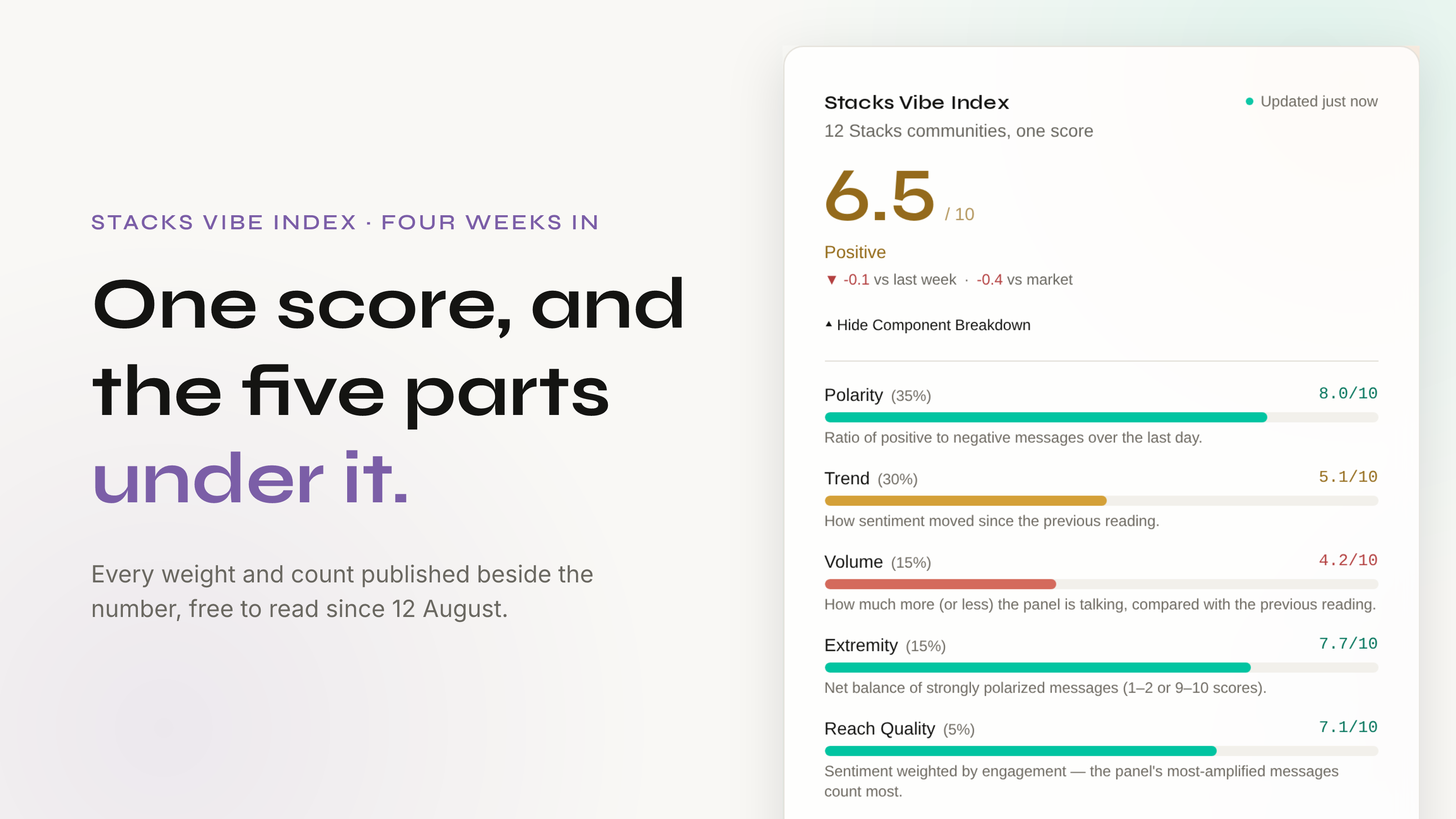
The page leads with one composite score out of ten. On 15 September it read 6.5.
Underneath sit the five parts that produced it, each with its weight: polarity at 8.0, trend at 5.1, volume at 4.2, extremity at 7.7, reach quality at 7.1. A reader who thinks volume deserves more than its 15% can see exactly how much of the headline it is moving.
Then the counts. In the seven days to 15 September the panel carried 1,871 messages from 644 distinct voices across 24 connected sources. The week before it was 2,075. Those are on the page because a sentiment score without them is a vibe about a vibe.
The same numbers come back as JSON from stacks.vibewatch.io/api/index, with no key and no sign-up. That is the part that matters most to us. Publishing a score is easy. Publishing the arithmetic under it means somebody can check.
The number went down this week, and the parts say why
On 15 September the composite read 6.5, a tenth below where it sat a week earlier. Polarity sits at 8.0, which is high — the tone of what people wrote was strongly positive. Volume sits at 4.2, which says the panel is talking less than it was, and trend at 5.1, which says sentiment has barely moved since the previous reading. Between them those two carry 45% of the weight, and they are what pulled the composite down while what people wrote stayed positive.
That is a real thing a community lead would want to know: the room liked the news and the room got quieter. Those are different facts and a single score hides one of them unless you publish the parts.
Seven per cent of the week happened where crawlers cannot go
The source mix for the seven days to 15 September: 92% X, 7% Discord, 1% forum, and Telegram rounding to zero.
Seven per cent is a small slice and we are not going to inflate it. What it is, though, is a slice that a social listening tool physically cannot reach. A Discord server is not indexed anywhere, and nothing will return every mention inside one on request. The only way in is a bot with real membership of the server, which is what the panel projects granted.
The share varies week to week with whatever the ecosystem is doing. On a launch week, X floods and the inside rooms look small next to it. On a quiet week, the proportion shifts. Either way the questions people ask inside a server are not the ones they post publicly.
Nine of twelve projects carry a score, and the other three say so
The panel is twelve projects. Nine of them have a score this week. Boom, Jing Swap and Scaffold Stacks do not, because they did not clear the volume a score needs.
They still appear on the page, listed without a number. The alternative — quietly dropping a project until it gets noisy enough — would make the panel look healthier than it is and would hide the thing a small project most wants to know, which is that it is small.
The index also marks whether a week-over-week comparison ran against the same panel or a changed one. An ecosystem read that silently swaps its membership between weeks is not a trend.
What the Monday report surfaces
The score is the top of it. The written report every Monday is where the specifics live, and the section we get the most out of is the one that lists what needs answering.
The 7 September report carried three: a recurring claim that Bitcoin Staking really pays sBTC rather than BTC, which a founder replied to directly; unclear mechanics on a rewards campaign, where people were asking whether one route needed a separate opt-in; and a run of questions from holders who missed a bond window because their STX was locked elsewhere.
None of those are sentiment. They are the support queue, the documentation gap and the FAQ, pulled out of a week of conversation in the order they mattered. A community manager reading that on Monday morning knows what to write.
What this does not prove
It does not prove the score is correct. There is no ground truth for how an ecosystem feels, and anyone selling you one is selling a feeling with a decimal point on it.
What four weeks in public does prove is narrower and more useful: the pipeline runs on a real ecosystem without a human tidying it, the counts are stable enough to publish, and the parts move independently in ways that match what happened that week. When the bond sold out, polarity climbed. When the week went quiet, volume fell and said so.
The index is the version of this we can show you without asking for anything. Stacks Endowment funded it precisely so it could be free to read. The private version is the same machinery pointed at one community, with every message searchable and a weekly report written for the team that runs it.
If you want to see the shape before you decide anything, the index is live and the demo is open.