
Agencies and freelance community managers choose the tools their clients run. That recommendation is usually unpaid work. You test the thing, the client buys it, and your side of it ends there.
Vibewatch pays for it now. When a team you referred subscribes, half of every payment they make comes to you for the next twelve months.
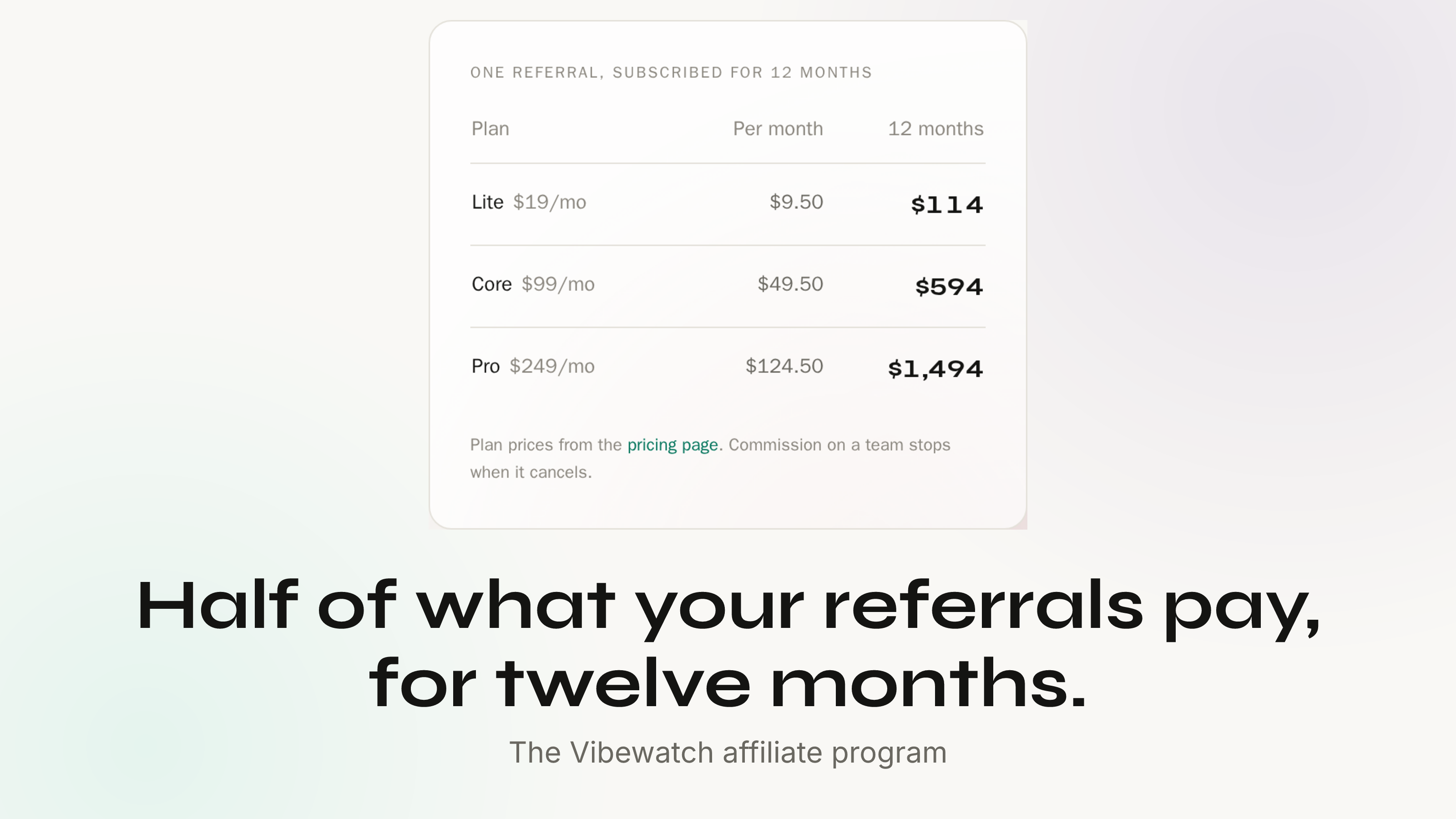
What one referral pays
Commission is a share of what they pay, so it follows whichever plan the team picks.
| Plan | Per month | 12 months |
|---|---|---|
| Lite, $19/mo | $9.50 | $114 |
| Core, $99/mo | $49.50 | $594 |
| Pro, $249/mo | $124.50 | $1,494 |
Those are the three plans on the pricing page, at what a team pays for them today. The rate is 50% on all three, and it never steps up or down with how many teams you have sent.
What earns nothing
Paid months only.
A free trial earns nothing, a sign-up earns nothing, and a $0 month earns nothing, so your first commission arrives with the team's first paid month. Each commission then waits thirty days before it can be paid out, which is the refund window. A payment refunded or charged back inside those thirty days cancels its commission too.
Commission on a team ends when that team cancels, and it ends at twelve months either way. There is no lifetime tail on it.
Why a share instead of a bounty
The first design we costed was a flat bounty: $100 once a referred team had paid us $100. It is the easier offer to say out loud, and on a Pro referral it pays in the same month a share does.
Everywhere else it pays worse. We set no minimum payout, so a Core referral's $49.50 is yours once its first month clears the hold, where the bounty needs two months to reach $100 and a Lite referral needs six. Over the twelve months the share also pays more on all three plans. That decided it.
What you are recommending
Vibewatch is community intelligence for web3 teams. Its bot joins a community's own Discord and Telegram and reads them from the inside, takes in X and the other public platforms beside them, scores every message in context, and sends the team one weekly report of what was said, what is trending, and what is worth addressing.
Two surfaces are open without an account, so a client can look before they talk to anyone. The live demo is a seeded organization running the real dashboard. The Stacks Vibe Index scores the Stacks ecosystem in public, with the message and voice counts published under the number. Built for web3 teams is the short version of who buys it and why.
Who the program suits
Three groups, in the order we go looking for them. Freelance community managers and agencies running several web3 communities, who already pick the stack their clients pay for. Newsletters and communities whose readers are community managers. Crypto accounts whose audience includes the founders of projects.
It is a bad fit for a trading audience. Vibewatch scores a community for the team that runs it and carries no trading signals, so a feed built around price calls is the wrong room for this.
The link, the dashboard, and getting paid
Dub runs the program. Your link sets a cookie on vibewatch.io, and when someone who arrived through it creates an organization, Vibewatch hands the click id to Dub. The sign-up shows in your dashboard before the team has paid anything, so you can see a referral working before it pays. Commissions land there as each payment clears.
Payouts go out once a month, covering every commission past its hold. Dub sends your balance to a bank account or pays it in USDC, collects your tax forms, and sets its own transfer fees. It deposits a balance over $10 on its own; below $10 it waits for a manual withdrawal that costs $0.50, so a lone Lite referral's $9.50 stays put until the next month's commission joins it. The thresholds and the fees are in its payout guide.
Applications are approved automatically, and one that Dub's screening flags as risky waits for us to read it by hand. The terms in full and the form are on the affiliates page; anything that page does not answer goes to hello@vibewatch.io.