
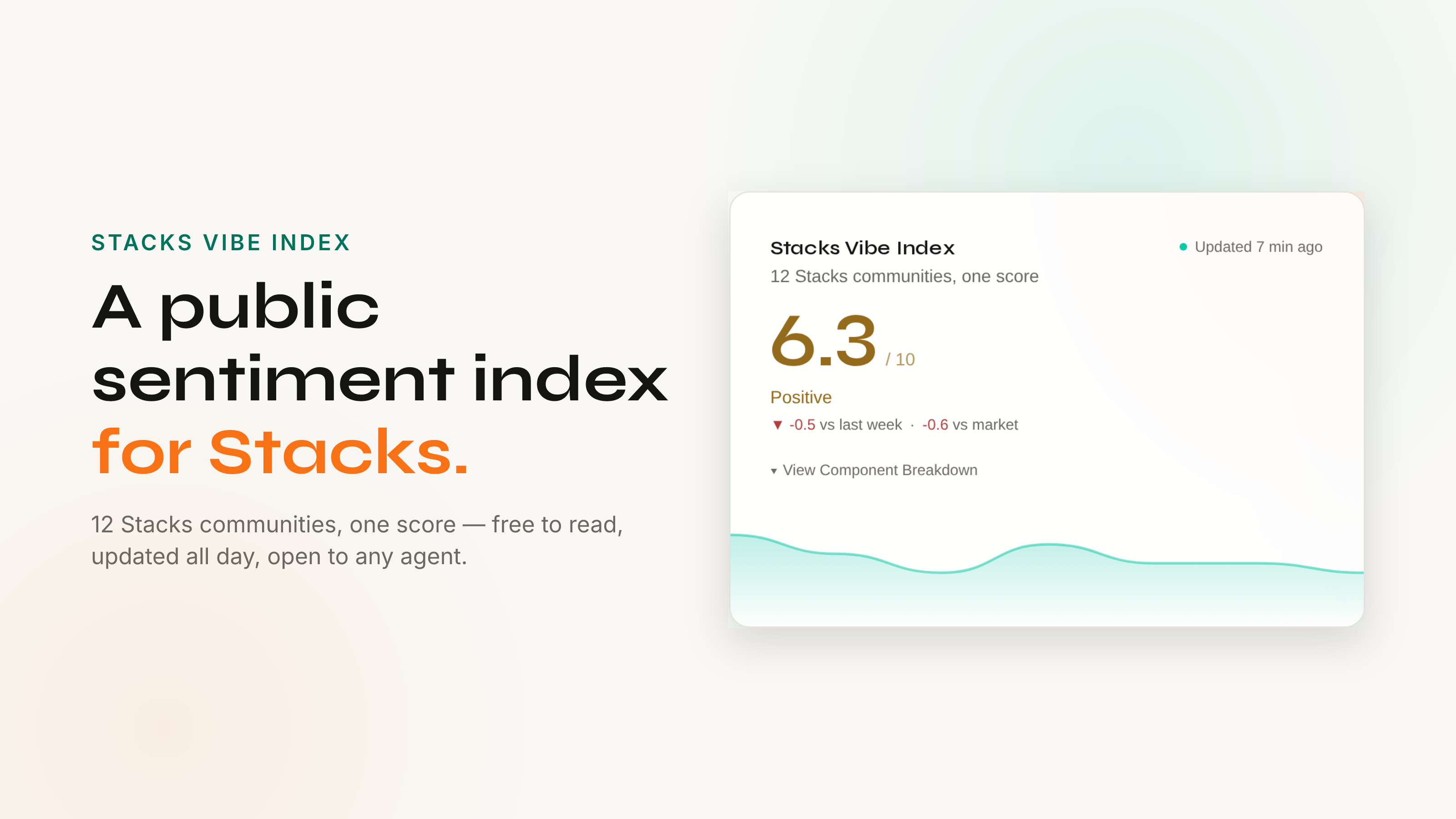
In July we wrote about the Stacks Endowment grant and what we intended to build with it: one open, public view of community sentiment across the Stacks ecosystem, free for anyone to read.
It's live at stacks.vibewatch.io.
Twelve Stacks communities publish into it. It updates on every sync, all day. Nobody needs an account to read it, and nothing about it sits behind a form.
What the index actually measures
The headline number is one score out of ten — an equal-weight composite across every project on the panel, so no single large community drags the ecosystem read around on its own. Under it sit the parts that produced it: polarity, velocity, volume, extremity, and engagement, each with its own weight, each inspectable on the page.
Around that, the index carries the things you need to know whether to trust the number. How many messages it read in the last seven days. How many distinct people were talking. How many sources are connected. Which projects are on the panel, and whether the week-over-week comparison is against that same panel or a changed one. When a slice is too thin to score honestly, it's marked as suppressed rather than quietly dropped.
A sentiment number with no denominator attached is a vibe about a vibe, so the index publishes the denominator.
Why it can see conversation other tools can't
Public-web listening tools read X, news, and public forums. That's a real slice of a crypto ecosystem's conversation, and it's the loudest one — 88% of the messages on the Stacks panel in the week to September 1, 2026.
The other 11% came from inside Discord servers and Telegram groups, where no public crawler can reach. (The remainder is forum posts.) Every project on the index runs Vibewatch inside its own community, by its own invitation, which is what makes those messages countable at all.
It's a small share of the volume and a large share of the substance. Governance arguments happen in Discord. Bug reports and unfiltered launch reactions happen in Discord. The considered version of a complaint that shows up on X as one annoyed sentence happens in Discord, with the reasoning attached. That's the material a community team actually needs, and it's exactly the part a public-web tool structurally cannot get to.
Every project scored in its own context
An ecosystem-wide sentiment sweep run by a generic tool has one vocabulary for twelve different communities. "Bond" means something specific on Stacks. So does a complaint about gas, or a debate about custody, or the word "dump."
Each project on the index has its own Vibewatch dashboard, and every message is scored knowing that project's context — its product, its token, its slang, and what its community counts as good news. When a team corrects a score, Vibewatch learns from it. Twelve individually context-aware reads add up to a sharper index than one generic pass over the whole ecosystem.
A written report every Monday
The number tells you the temperature. The weekly report tells you what happened.
Every Monday, the index publishes a written breakdown of the week that just closed: the themes that dominated, which projects drove them, the questions that kept coming back, and what moved the score. It's the same kind of narrative report every Vibewatch customer gets for their own community, written from the panel's messages rather than from a press cycle.
The reports are dated by the week they cover, so the report dated August 24 covers August 24 through August 30.
Built for agents, with no key
Everything on the index page is available as structured JSON — free, no auth, no key:
curl https://stacks.vibewatch.io/api/index
One request returns the composite score and its components, the panel metadata, per-project scores, and the source mix. Every response carries a schema_version and an as_of timestamp in UTC, so an agent can tell how fresh the data is and whether the shape changed under it. Suppressed slices are marked rather than omitted. The same data is queryable through the Vibewatch MCP server.
Stacks has a fast-growing agent economy, and an ecosystem sentiment read is a genuinely useful thing for an agent to have. Making it free and keyless was the shortest path to finding out what people build with it.
If you're building on Stacks
The index is the public view. Every project on it also gets the private one: every message from every connected source, searchable across Discord, Telegram, X, and more, with a weekly report their whole team reads.
Vibewatch is community intelligence for web3 teams, and the index is a public good built on the same product. If you run a Stacks project and want to be on the panel — or just want the dashboard for your own community — start here and tell us you're on Stacks.
Frequently asked questions
What is the Stacks Vibe Index? A public, aggregated read on community sentiment across the Stacks ecosystem, built by Vibewatch and funded by a Stacks Endowment grant. It scores 12 Stacks communities into one number, updates all day, and is free for anyone to read at stacks.vibewatch.io.
Does it cost anything to read? No. The page is public, and the JSON API behind it is free with no key and no account.
Which projects are on the index? The current panel is listed on the index page itself, and every project on it opted in to publish. The panel metadata is also in the API response, so you can see exactly who was included in any given reading.
How is this different from a social listening dashboard? Two ways. It reads inside the Discord servers and Telegram groups where each community actually talks, because each project invited Vibewatch in — in the week to September 1, 2026 that was 11% of the messages, and it's the part public crawlers can't reach. And each project is scored in its own context rather than swept with one generic model.
How often does it update? The score updates on every sync throughout the day. The written report publishes every Monday, covering the week that just ended.
Can I use the index data in my own app or agent? Yes. GET https://stacks.vibewatch.io/api/index returns the whole page as structured JSON, free and without a key, and the same data is available through the Vibewatch MCP server. Responses are versioned and timestamped.
Do I have to be a Stacks project to use Vibewatch? No. Vibewatch is community intelligence for any web3 team. The Stacks Vibe Index is a public good built on top of the product every Vibewatch customer already uses.
Plans start at $19/mo, with your first weekly report on us. Start a free trial to get the same read on your own community.